

A complete conversation intelligence implementation gives a contact center more than recorded calls, transcripts, or dashboards. It connects reliable interaction data with validated integrations, calibrated analytical rules, defined workflows, and measurable outcomes. Use this checklist to identify missing requirements, assign owners, and decide whether the program is ready to pilot, launch, or scale.
What Counts as a Complete Conversation Intelligence Implementation?
A conversation intelligence implementation is complete when reliable data, validated systems, approved governance, calibrated scorecards, assigned owners, adopted workflows, and measurable operational outcomes operate together.
Platform Access Is Not the Same as Operational Intelligence
As Aircall documents in its 90-day implementation guide, the platform goes live in week one. The operational system, the part that changes how managers coach, takes considerably longer to build properly. A contact center with active recordings and an unused dashboard has platform access. One with calibrated scorecards, weekly coaching cadences, and measurable outcome comparisons has operational intelligence.
Six Conditions That Prove the Implementation Is Operational
| Condition | Completion Evidence | Failure Signal |
| Interaction data is complete | Representative calls ingest and transcribe without errors | Missing recordings or wrong metadata |
| Integrations work end to end | Summaries and scores appear in correct CRM records | Data stays in a separate dashboard |
| Governance controls are approved | Access, retention, and redaction policies are active | No named data owner |
| Taxonomies and scorecards are calibrated | AI and human scoring agree within an approved threshold | Reviewer disagreement exceeds threshold |
| Findings trigger owned workflows | Flagged interactions reach the defined reviewer on time | Findings accumulate without action |
| Results compared with baselines | KPIs measured against pre-implementation values | No baseline was recorded |
Step 1: Assess Current Readiness and Define Implementation Scope
- Identify the current implementation stage
- Select two or three specific business problems such as low quality assurance (QA) coverage, inconsistent coaching, or compliance gaps
- Define what is inside and outside the initial scope by team, channel, and language
- Record baseline metrics before any intervention begins
Every acceptance criterion must be set by the organization based on operational risk and interaction volume.
Step 2: Assign Ownership and Governance Responsibilities
Assign a named owner to every workstream: taxonomy, scorecard, integration, coaching workflow, and measurement. Define human oversight responsibilities for compliance violations, compensation decisions, disputed evaluations, and high-risk escalations. Document version control requirements for every taxonomy, scorecard, and automated rule change.
| Workstream | Accountable Owner | Escalation Path |
| Taxonomy and scorecard | QA and analytics lead | Program owner |
| CRM and CCaaS integration | IT with operations validation | Integration owner |
| Privacy and governance | Compliance and data owner | Legal |
| Measurement and reporting | Analytics lead | Executive sponsor |
Step 3: Prepare Interaction Data and Technical Architecture
The technical foundation is ready only when representative interactions can be captured, transcribed, enriched with metadata, and moved through connected systems without loss.
- Inventory every conversation source and required metadata field
- Choose real-time analysis for live agent guidance and alerts, post-interaction analysis for QA and coaching, or a combination
- Test recording availability, audio quality, transcription accuracy, speaker separation, and language support
- Validate that customer relationship management (CRM), contact center as a service (CCaaS), ticketing, and QA integrations place outputs in the correct records
Conversation intelligence only reaches its full potential when connected to the systems the rest of the business runs on. Without CRM integration, agents are context-blind before each call.
Step 4: Complete Privacy, Security, and Compliance Checks
- Verify recording and notification requirements for the relevant jurisdiction without applying one jurisdiction’s rules universally
- Define role-based access, data residency, retention, deletion, and personally identifiable information (PII) redaction controls
- Identify every use requiring human confirmation before an AI result is acted upon
- Document all product-specific limitations by naming the exact vendor and configuration they apply to
Step 5: Build the Conversation Taxonomy and QA Scorecard
The taxonomy classifies what happened in an interaction. The QA scorecard evaluates whether defined behaviors, processes, or outcomes met the organization’s criteria. These are separate frameworks with different owners.
| Attribute | Conversation Taxonomy | QA Scorecard |
| Purpose | Classifies interaction content | Evaluates defined performance criteria |
| Output | Category labels | Scores or evaluation results |
| Owner | QA and analytics lead | QA lead |
| Failure condition | Generic categories not tied to actual calls | Vendor-default scorecard not calibrated |
For each taxonomy category, define the name, purpose, inclusion and exclusion criteria, an example, and the downstream action it triggers. Map every insight to a named action, owner, destination workflow, response time, and outcome metric. Establish version control so every rule change is documented and retested. For criteria, weighting and a worked template, see how to build a call center QA scorecard.
Step 6: Run a Controlled Conversation Intelligence Pilot
A pilot tests whether the data, integrations, analytical rules, governance controls, and workflows function under representative contact center conditions. Set acceptance, revision, and stop criteria before the pilot begins across:
- Data quality
- Scoring accuracy
- Integration reliability
- Workflow usability
- Agent reception
Include routine interactions and difficult edge cases. Collect structured feedback from agents, supervisors, and QA reviewers. A universal pilot size, duration, or accuracy threshold was not found in neutral implementation guidance; every threshold must be defined by the organization.
Step 7: Calibrate AI Findings Against Human Review
Calibration compares AI-generated findings with an agreed human-reviewed reference set, identifies false positives and false negatives, and determines whether the analytical rules are reliable enough for the intended workflow.
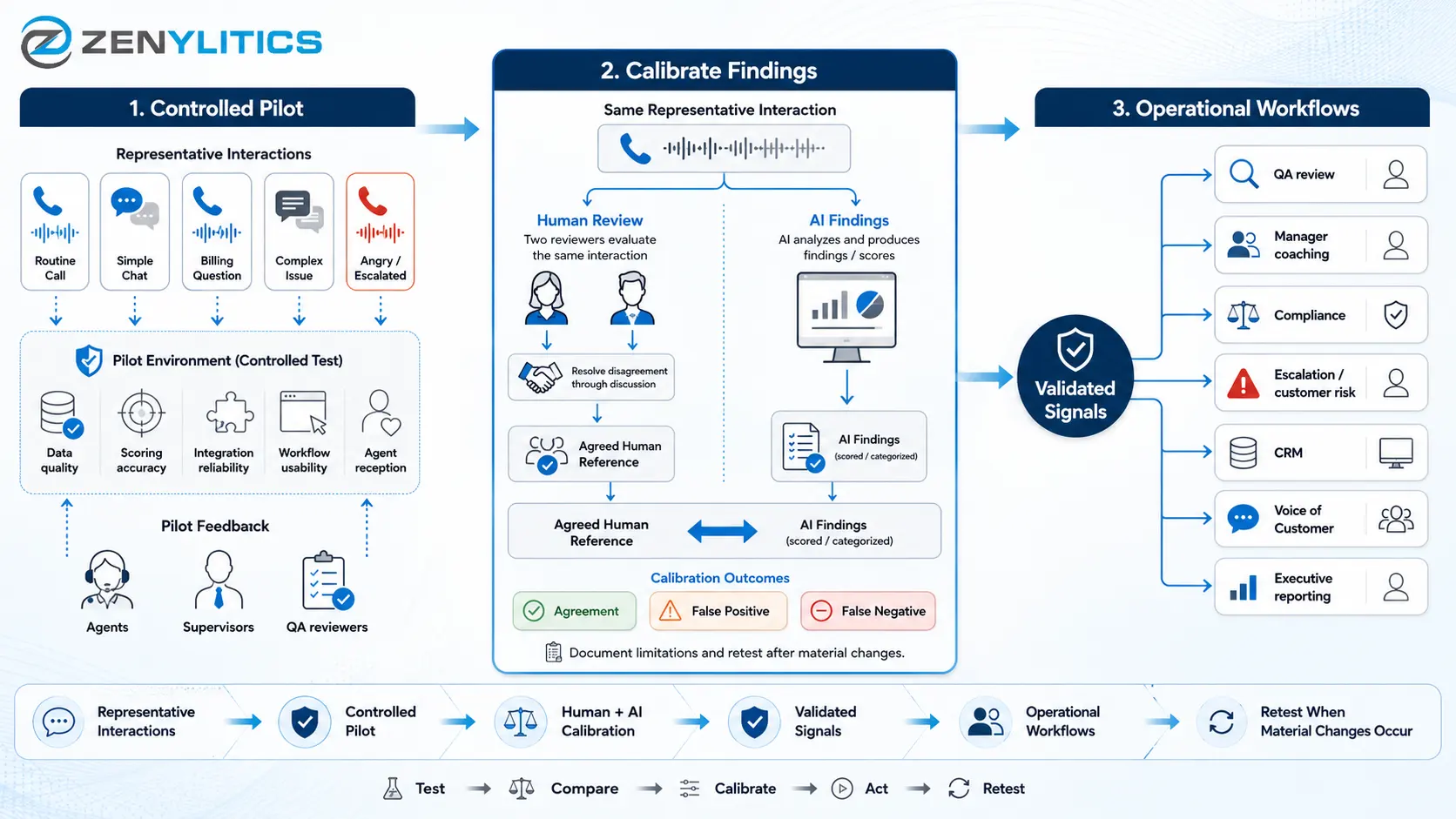
- Resolve disagreement between human reviewers before comparing results with AI output
- Document known limitations rather than concealing them
- Retest after every material change to rules, thresholds, or models
Our guide to AI-scored quality management covers how automated scoring and human review work together.
Step 8: Activate QA, Coaching, Compliance, and CRM Workflows
Conversation intelligence becomes operational only when detected signals reach defined people, systems, and follow-up processes. Instead of reviewing a small sample of calls manually, managers have scored data from 100 percent of calls, changing coaching from reactive to systematic.
- Build a repeatable coaching workflow defining the trigger, owner, evidence, action, goal, and reassessment schedule
- Route compliance, escalation, and customer risk signals to named owners with documented response times
- Send relevant findings into CRM, voice of customer, and executive reporting workflows
Step 9: Train Managers, Agents, and Program Owners
Training must be role-specific:
- QA and analytics teams: taxonomy management, scorecard administration, calibration procedures
- Managers: reading scored outputs, identifying coaching patterns, running structured sessions grounded in rubric criteria
- Agents: what is being evaluated, why, how results will be used, and how to challenge a disputed score
- Leaders: how to interpret findings and communicate limitations accurately to stakeholders
Step 10: Measure Implementation Health and Operational Impact
Measure four categories separately. Do not confuse activity with outcomes.
| Metric Type | Examples |
| Setup | Recording coverage rate, transcription completion rate |
| Analytical quality | Human-AI agreement rate, false-positive rate by category |
| Adoption | Manager usage rate, coaching session completion rate |
| Operational KPIs | First-call resolution (FCR), average handle time (AHT), CSAT, QA score, compliance adherence |
Convert findings into leadership-ready intelligence by answering five questions: what changed, what caused the change, why it matters, what response is appropriate, and how the outcome will be measured. Use the same pre-implementation baseline to calculate conversation intelligence ROI once the program has run long enough to show results.
Step 11: Optimize the Program and Decide Whether to Scale
Scale only after the implementation demonstrates stable data, reliable integrations, calibrated scoring, adopted workflows, functioning governance, and measurable KPI movement. Recalibrate after every material change to the business, product, team, taxonomy, or technology. Maintain a monthly or quarterly governance review covering scoring consistency, adoption rates, data quality, and pending rule changes.
What Additional Requirements Apply to Complex Contact Centers?
The 11-step checklist covers most implementations. Some environments require additional work:
- Multilingual and omnichannel: separate transcription testing, taxonomy validation, and calibration per language and channel
- Regulated and cross-border: jurisdiction-specific review of recording notice, data residency, and retention obligations
- Multi-site and outsourced: governance for data ownership and audit continuity across organizational boundaries
- Legacy recordings and generative AI evaluations: format, quality, and consent review before ingestion
Common Conversation Intelligence Implementation Failures
| Failure | Step That Prevents It |
| Technology selected before business problem | Step 1 |
| No accountable program owner | Step 2 |
| Data flows but is not validated | Step 3 |
| Generic vendor taxonomy not calibrated | Step 5 |
| Uncalibrated scorecard used for consequential decisions | Step 7 |
| Findings stay in dashboards without workflow routing | Step 8 |
| Agents perceive the program as surveillance | Step 9 |
| Activity volume treated as operational impact | Step 10 |
| Expansion begins before core implementation is stable | Step 11 |
Do You Need Software Only or Managed Analytics Support?
Evaluate whether the organization has platform administration capacity, integration support, taxonomy expertise, scorecard ownership, calibration capability, governance resources, and ongoing optimization capacity. A contact center missing several of these capabilities after platform go-live is likely to find that findings accumulate without producing operational change.
Managed support becomes relevant when the platform is live but findings are not reaching decision-makers, when no one owns taxonomy or scorecard maintenance, when calibration has stopped, or when program management is fragmented without a named owner.
Guided Insights as a Service from Zenylitics provides the analyst staffing, scorecard architecture, ongoing taxonomy calibration, human review workflows, and leadership-ready reporting that organizations need when platform access alone is not producing operational value. Iteration 0, Zenylitics’ proprietary onboarding methodology, delivers first program findings within 90 days. This is a Zenylitics-specific service commitment, not a universal implementation timeline.
For organizations whose platform outputs are not consistently reaching senior leadership, Dossier delivers statistically validated, analyst-reviewed briefings as email, audio, and video on a recurring schedule.
Request a Conversation Analytics Assessment
FAQs
How long does implementation take?
A 30-to-90-day phased model is a common planning framework. Actual duration depends on data readiness, integration complexity, governance review, and rollout scope.
Who should own the implementation?
A cross-functional group covering operations, QA, IT, compliance, and training with a named program owner and executive sponsor.
How many interactions should be in a pilot?
The sample must represent the queues, channels, languages, and interaction types in the intended rollout. No universal size applies.
How should AI scoring accuracy be validated?
Human reviewers score a representative set independently, resolve internal disagreement, then compare the agreed result with AI output. The organization defines an acceptable threshold.
How often should taxonomies and scorecards be recalibrated?
After any material change to the business, product, agent population, or technology. A monthly or quarterly governance review should include a calibration health check.
When is the program ready to scale?
When the core implementation demonstrates stable data, reliable integrations, calibrated scoring, adopted workflows, and at least one measurable KPI that moved against the pre-implementation baseline.