
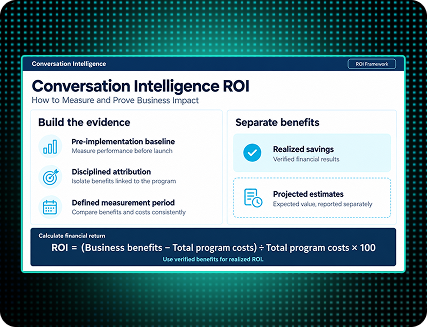
Conversation intelligence ROI is the measurable financial return a contact center generates from its conversation analytics investment, calculated by comparing net business benefits against total program costs over a defined period. Proving it requires a pre-implementation baseline, a disciplined attribution method, and separation of realized savings from projected estimates.
| Quick answer
Conversation intelligence ROI is the measurable financial return from a conversation analytics investment: net benefit divided by total program cost, multiplied by 100, over a defined period. Proving it requires a pre-implementation baseline, a disciplined attribution method, and keeping realized savings separate from projected estimates. Key takeaways
|
Most conversation intelligence ROI cases fail at the proof stage, not the implementation stage. As Forrester’s Total Economic Impact study of the Gong platform shows, organizations using the platform saw a three-year ROI of 481 percent. The gap between a vendor’s projected ROI and a number a CFO will accept comes down to measurement discipline.
What Counts as Conversation Intelligence ROI?
The Evidence Chain From Conversation Data to Financial Value
ROI requires a complete chain: conversation data is captured, analyzed, and converted into a finding that changes an operational decision, which produces a measurable financial outcome. Each link in that chain must hold.
What Does Not Prove Conversation Intelligence ROI?
Call volume processed, dashboard logins, transcript counts, and sentiment scores are activity metrics. They confirm the system is running, not that it is producing business value.
Projected ROI vs Realized ROI
Projected ROI is a vendor estimate built from industry averages. Realized ROI is measured from your own pre-implementation baseline against documented outcomes. Only realized ROI belongs in a business case.
Gross Benefit vs Net Benefit
Gross benefit is the total value of outcomes before deducting program costs. Net benefit is gross benefit minus all associated costs. ROI should always be expressed as net.
Why There Is No Universal Conversation Intelligence ROI Benchmark
The vendor-commissioned Forrester studies listed below report three-year ROI between 244 percent and 481 percent, but that range reflects vastly different use cases, team sizes, and cost structures. A benchmark from one environment cannot be assumed to apply to yours.
What Should You Define Before Measuring Conversation Intelligence ROI?
Start With a Specific Business Problem
Every ROI calculation begins with a defined operational problem. Increasing coaching consistency, closing a compliance coverage gap, and reducing repeat contacts all point to different metrics, different baselines, and different proof requirements.
Establish a Defensible Performance Baseline
Capture three to five metrics before any coaching or operational intervention begins. These are the “before” numbers your post-implementation results will be measured against.
Identify the Systems of Record
Agree in advance which systems will provide the official performance data for the measurement period. Disagreements about data sources invalidate results after the fact.
Grade the Strength of the Evidence
Not all evidence carries equal weight. A pilot-and-control-group result is stronger than a before-and-after comparison, which is stronger than a vendor benchmark. Label each data point accordingly.
Which Business Outcomes and Metrics Can Create Measurable Value?
Efficiency and Productivity Recovery
Time recovered from manual call review, report writing, and CRM documentation. This is typically the earliest and most straightforward benefit to quantify.
Revenue, Retention, and Collections
Improvements in sales conversion rate, upsell frequency, retention rate, or collections recovery rate where conversation data directly informed the coaching or process change.
Quality, Compliance, and Risk Reduction
Reduction in compliance violations, faster issue detection, and reduced regulatory exposure. Cost avoidance from prevented violations is a legitimate benefit when documented.
Customer and Strategic Outcomes
First-call resolution, CSAT, and repeat contact rate improvements. These are real but take longer to move and require more careful attribution.
Leading Indicators vs Lagging Indicators
Coaching completion rate and scorecard calibration quality are leading indicators. Win rate and retention rate are lagging indicators. Both belong in an ROI framework, but they operate on different timescales.
Hard Benefits, Assumption-Based Benefits, and Strategic Value
Label every benefit by type. Hard benefits have a direct dollar value. Assumption-based benefits require a stated conversion rate to become financial. Strategic value, such as improved leadership visibility, is real but does not belong in the ROI numerator without a documented financial link.
What Costs Belong in the Total Conversation Intelligence Investment?
Platform, Data, and Usage Costs
Licensing fees, data storage, and per-interaction processing charges if usage-based pricing applies.
Implementation and Integration Costs
Initial configuration, CRM and CCaaS integration work, and any professional services fees charged at go-live.
Internal Labour and Change-Management Costs
The internal staff time required to manage the program, train users, run calibration sessions, and maintain the taxonomy and scorecard on an ongoing basis.
Governance, Privacy, and Ongoing Ownership Costs
Data governance review, privacy compliance work, and the ongoing cost of human analyst oversight if required by policy or regulation.
How Do You Calculate Conversation Intelligence ROI?
The Conversation Intelligence ROI Formula
ROI percentage equals net benefit divided by total investment, multiplied by 100. Net benefit equals total realized benefit minus total program cost.
How to Define Each Variable
Total realized benefit is the sum of documented hard benefits and assumption-based benefits at stated confidence levels. Total program cost is the sum of all cost categories described above.
How to Monetize Productivity Without Overstating Savings
Recovered hours become a financial benefit only when those hours produce incremental revenue or replace a billable cost. A supervisor who recovers two hours of manual QA time per week has only produced a financial benefit if those hours were redirected to a measurable output.
Illustrative Conversation Intelligence ROI Calculation
A contact center with 50 agents implements automated QA scoring. Manual review cost before implementation was $180 per agent per month in supervisor time (six hours at $30 per hour). After implementation, that drops to $60 per agent per month. Net productivity saving: $120 per agent per month, or $72,000 annually across 50 agents. Platform and implementation cost: $40,000 annually. Net benefit: $32,000. ROI: 80 percent.
Conservative, Expected, and Optimistic Scenarios
Build three versions of every ROI model. The conservative scenario uses the lowest defensible benefit estimate and the highest documented cost. The expected scenario uses mid-range estimates. The optimistic scenario states the assumptions explicitly.
What is the expected ROI for conversation intelligence software?
A first-year ROI of 50 to 150 percent from productivity and QA efficiency gains is Zenylitics’ illustrative estimate for contact center implementations where baseline data exists. The worked example above, with $72,000 in savings against $40,000 in cost, produces an 80 percent ROI, which sits inside that range. Revenue impact claims above that level require documented before-and-after comparison with attribution controls applied.
What ROI have other companies seen with conversation intelligence?
Published results range from 244 to 481 percent three-year ROI in vendor-commissioned Forrester studies, to a 14 percent productivity gain for customer support agents in an independent study, to more than 8 points of conversion improvement in a Zenylitics engagement. The table lists each result with its source, year, and study type.
| Company / study | Result | Source (linked) | Year | Type |
| Gong Revenue Intelligence Platform (Forrester Total Economic Impact) | 481 percent three-year ROI, with payback in under six months, for a modeled B2B software company with 750 sellers | Forrester Consulting report for Gong | 2021 | Vendor-commissioned study |
| Outreach platform, including conversation intelligence (Forrester Total Economic Impact) | 244 percent three-year ROI, with payback in under six months | Outreach report page for the Forrester study | 2026 | Vendor-commissioned study |
| Verint customer engagement solutions (Forrester Total Economic Impact) | 391 percent three-year ROI, with payback in under six months, modeled from five customers using a mix of Verint solutions | Verint press release on the Forrester study | 2021 | Vendor-commissioned study |
| Rippling, using Gong | 13 percent increase in win rates and 15 percent increase in customer lifetime value | Gong case study on Rippling | Not stated | Vendor case study |
| Brynjolfsson, Li, and Raymond, “Generative AI at Work” (customer support agents using an AI assistant) | 14 percent more issues resolved per hour on average and 34 percent for novice agents, across 5,179 agents | NBER Working Paper 31161 | 2023 | Independent study |
| Consumer-finance sales organization (Zenylitics) | More than 8 points of conversion improvement, to a sustained rate above 30 percent | Zenylitics case study | 2026 | Zenylitics engagement |
Vendor-commissioned studies model a composite company built from a small number of customer interviews, so each result describes a hypothetical organization. The Gong report itself advises readers to use their own estimates, which makes these figures an upper range for planning. The Zenylitics result comes from a consumer-finance sales organization that reported its conversion rate directly to the team.
What KPIs improve after a conversation intelligence rollout?
QA coverage, compliance misses, conversion or close rate, average handle time, first-call resolution, coaching time, and CRM completeness are the KPIs a contact center can baseline and track after a rollout. Each one needs a pre-rollout baseline from your own systems of record. The table shows what changes, how to measure it, and when results usually appear.
| KPI | What changes | How to measure it | When you usually see it |
| QA coverage | The share of calls scored increases when automated scoring replaces manual sampling | Scored calls divided by total calls in the period, from the QA platform | Within the first 30 to 90 days, as first insights arrive |
| Compliance misses | Missed disclosures and policy violations are detected across a larger share of calls | Violations found per 1,000 reviewed calls, compared with the baseline | Detection within the first 30 to 90 days, with financial value from compliance improvements at months four to six |
| Conversion or close rate | The share of qualified opportunities that convert changes where coaching targets behaviors tied to conversion | Conversions divided by qualified opportunities, from the CRM or sales system | Months four to six |
| Average handle time | Handle time can shift as after-call work decreases, so read it alongside first-call resolution | Average talk time plus after-call work, from the ACD or CCaaS platform | Months four to six |
| First-call resolution | The share of issues resolved on the first contact changes as coaching addresses repeat-contact causes | Contacts with no repeat contact inside a defined window, from the case management system | Months four to six or later, since customer outcomes take longer to move |
| Coaching time | Supervisor time spent finding calls to review decreases and time spent coaching increases | Supervisor hours per agent per month in review and in coaching, from time logs or the scorecard tool | Within the first 30 to 90 days |
| CRM completeness | Required CRM fields are populated more consistently after each call | Populated required fields divided by total required fields, from a CRM report | Within the first 30 to 90 days |
How Do You Attribute and Prove Business Impact?
Pilot vs Control Group
A pilot group using conversation intelligence compared against a control group not using it is the strongest attribution design. The control group must be comparable in size, experience, and interaction type.
Matched Cohorts and Phased Rollouts
When a control group is not feasible, match agents by performance tier and compare their trajectories after rollout against agents whose rollout was delayed by one quarter.
Before-and-After and Historical Trend Comparisons
Compare post-implementation metrics against the documented pre-implementation baseline. Account for seasonal trends before attributing change to the program.
Control for Confounding Factors
Document any other changes that occurred during the measurement period: new leadership, product changes, market shifts, or concurrent training programs. Unexplained changes in a confounded environment cannot be attributed to conversation intelligence alone.
Apply an Attribution Confidence Factor
| Attribution Method | Confidence Level |
| Pilot vs control group | High |
| Matched cohort comparison | Medium-high |
| Before-and-after with confound controls | Medium |
| Before-and-after without controls | Low |
| Vendor benchmark only | Very low |
Stronger attribution makes conversation intelligence ROI more defensible.
Statistical Significance vs Business Significance
A result can be statistically significant but too small to justify program cost. A result can be business-significant but based on a sample too small to be statistically reliable. Both tests matter.
Validate the Result With Finance and Operational Owners
An ROI claim that has not been reviewed by a finance lead and the relevant operational owner is an internal estimate. Validation by those stakeholders is what converts it into a business case.
How Should Conversation Intelligence ROI Be Measured Over Time and Reported to Leadership?
Separate Time to Insight From Time to Financial Value
First insights typically arrive within 30 to 90 days. Financial value from coaching or compliance improvements typically emerges at months four to six. Leadership should not expect revenue impact data at the same time as the first scorecard outputs.
Build a Leadership-Ready ROI Scorecard
Track setup metrics, analytical quality metrics, adoption metrics, and operational KPIs in a single dashboard updated on a defined cadence. Separate each metric type clearly.
Turn Metrics Into an Executive Decision Story
Every leadership report should answer five questions: what changed, what caused it, why it matters, what the appropriate response is, and how the response will be measured. Raw metric tables without narrative do not support executive decisions.
Set the Reporting Cadence
Monthly reporting on adoption and analytical quality. Quarterly reporting on operational KPI movement against baseline. Annual reporting on financial ROI.
Decide Whether to Expand, Improve, Replace, or Discontinue
At each quarterly review, the program should be assessed against four options based on the evidence available. A program that is producing measurable value should expand. A program that is producing mixed results should be recalibrated before expansion.
What Zero or Negative ROI Means
Zero or negative ROI in the first two quarters usually reflects an adoption problem, a calibration gap, or a missing workflow connection rather than a fundamental platform failure. Identify the specific broken link before concluding the program does not work.
When Does Managed Analytics Help Close the ROI Measurement Gap?
Signs the Platform Is Producing Data but Not Business Action
Findings accumulate in dashboards without triggering coaching sessions, compliance reviews, or leadership decisions. Call data exists but no one owns the program outcome.
Where Internal Analytics Capacity Commonly Breaks Down
Taxonomy maintenance stops after go-live, scorecard calibration is not repeated, and the team responsible for analytical interpretation has no dedicated capacity. These are process failures, not technology failures. Teams weighing the decision can compare managed vs in-house conversation intelligence on deployment speed, total cost, and ongoing maintenance.
Where Zenylitics Fits When Internal Capacity Is Limited
Guided Insights as a Service from Zenylitics provides analyst staffing, scorecard calibration, human review workflows, and leadership-ready reporting for organizations whose internal teams cannot sustain the program management required to convert platform output into documented ROI. Iteration 0 delivers first findings within 90 days.
Dossier delivers statistically validated executive briefings on a recurring schedule for leadership teams that need finished intelligence rather than dashboard access.
Request a Conversation Analytics Assessment
Frequently Asked Questions
Is Conversation Intelligence Worth It for Small Sales and Support Teams?
For teams below 20 agents, the productivity benefit per agent must be weighed against fixed implementation costs. The ROI case strengthens significantly when compliance monitoring or collections performance is also in scope.
How Does Conversation Intelligence ROI Compare With Sales Training and Other Sales Tools?
Training ROI is hard to isolate because behavior change is gradual and attributed to multiple interventions. Conversation intelligence ROI is more measurable because the analytical layer provides before-and-after data on specific behaviors.
Can Tool Consolidation Count as a Conversation Intelligence ROI Benefit?
Yes, when conversation intelligence replaces a QA platform, a call recording tool, or a reporting system, the eliminated licensing and administration cost is a legitimate hard benefit.
Should Forecast Accuracy Be Included in Conversation Intelligence ROI?
Only if the conversation intelligence program directly informed a forecast change that produced a documented financial outcome. Claiming forecast accuracy improvement as a general benefit without a specific documented case overstates the ROI.
Does Cost Avoidance Count the Same as an Actual Cost Reduction?
In an ROI model, cost avoidance counts as a benefit when the avoided cost was real, the risk was documented before the program, and the avoidance can be reasonably attributed to the program. Label it separately from direct cost reduction and apply a confidence factor.
What ROI have other companies seen with conversation intelligence?
Forrester studies commissioned by Gong, Verint, and Outreach model three-year ROI between 244 and 481 percent for composite organizations, and a Zenylitics engagement shows more than 8 points of conversion improvement. Treat vendor-modeled figures as an upper range. Zenylitics regards a first-year ROI of 50 to 150 percent as an illustrative estimate. See the table above.
How do you calculate conversation intelligence ROI?
ROI percentage equals net benefit divided by total investment, multiplied by 100. Net benefit is total realized benefit minus total program cost, where realized benefit includes documented hard benefits and assumption-based benefits at stated confidence levels.
Why do conversation intelligence ROI cases fail?
Most fail at the proof stage, not implementation. Without a pre-implementation baseline and disciplined attribution, a vendor’s projected ROI never becomes a number a CFO will accept.