Conversation intelligence improves CRM accuracy by capturing what was actually said during customer interactions and writing structured data directly to CRM records without depending on manual input. The result is more complete records, more reliable pipeline data, and less administrative overhead across sales and contact center teams.
The Core Shift: From Manual CRM Notes to Conversation-Based CRM Updates
Traditional CRM hygiene depends on reps remembering what happened on a call, having time to log it accurately, and prioritizing documentation over the next interaction in their queue. All three conditions fail regularly under volume pressure.
Conversation intelligence changes the input source. Instead of relying on rep recollection after the fact, the system draws directly from what was recorded. A transcript of the interaction becomes the source of record, AI extracts structured data from it, and that data writes to the correct CRM fields automatically.
The shift is from CRM as a manual log to CRM as a continuously updated reflection of real customer conversations. That distinction matters for pipeline accuracy, forecast reliability, coaching quality, and compliance documentation.
What Manual CRM Data Entry Actually Costs Contact Center Operations
Sales reps spend an average of 3.4 hours a week entering customer information into a CRM, and 32 percent spend more than an hour on manual data entry every single day. For contact center operations running high call volumes, that overhead compounds quickly.
76 percent of CRM users say less than half of their organization’s CRM data is accurate and complete, and 37 percent report losing revenue as a direct consequence of poor data quality. When records depend on manual input, accuracy degrades under volume pressure, and the pipeline data that leadership relies on for forecasting reflects what reps chose to log rather than what customers actually said.
What CRM Accuracy Actually Means
A CRM record is accurate when it is complete, meaning all required fields are populated; current, meaning it reflects the most recent interaction; consistent, meaning the same data standard applies across all records; valid, meaning field values match expected formats and categories; and traceable, meaning each entry can be connected back to a real customer interaction. Conversation intelligence addresses all five dimensions when properly configured and integrated.
How Conversation Intelligence Automates CRM Data Capture
Guided Insights as a Service from Zenylitics applies managed speech analytics to this problem by connecting to existing contact center data, analyzing interactions at scale, and delivering structured findings to the teams and leaders who need to act on them. The same principle applies to CRM integration: conversation intelligence removes the manual steps that introduce error and delay into deal records.
The automated data capture sequence works as follows:
Conversation captured → Transcript generated → AI extracts structured data → CRM fields mapped → CRM write-back executed → Tasks and follow-up automation triggered → Audit and review applied
What Data Conversation Intelligence Extracts and Maps to CRM Records
The table below shows what a conversation intelligence platform captures from interactions and where that data typically maps inside a CRM.
| Data Extracted from Conversation | CRM Field or Object Updated |
| Agreed next steps and commitments | Task or follow-up activity record |
| Customer pain points and stated challenges | Opportunity notes or contact record |
| Objections raised | Opportunity stage notes or deal risk field |
| Stakeholders mentioned | Contact record or opportunity team |
| Competitor mentions | Opportunity field or deal intelligence section |
| Budget signals and timeline indicators | Close date or budget field |
| Deal risk signals | Forecast category or deal health score |
| Call outcome and disposition | Activity log or case resolution field |
Which Teams Get the Most Value
Sales reps benefit from the elimination of post-call logging. When summaries, next steps, and objection notes write automatically to the deal record, reps recover time that was previously spent on administration after each interaction.
Sales managers gain access to more complete and current deal records without depending on reps to maintain them. Pipeline reviews shift from interrogating data quality to evaluating actual deal health.
RevOps and CRM managers benefit from improved field completeness and consistency across the full pipeline. Automated updates reduce the inconsistency that arises when different reps apply different logging standards to the same interaction types.
Customer success teams can reference accurate interaction histories when they take over an account from sales. Documented pain points, stated timelines, and open commitments from the original sales conversation give handoff conversations a more complete starting point.
CRM Accuracy Improvements Driven by Conversation Intelligence
CRM accuracy improves across three dimensions when conversation intelligence automates data capture.
Completeness: Every conversation that runs through the system generates a record. There is no longer a dependency on rep discretion about which calls are worth logging. 76 percent of organizations report that less than half of their CRM entries are accurate and complete, a gap that automated capture directly addresses by making logging the default outcome rather than a deliberate action.
Timeliness: Records update in near real-time rather than at the end of a shift when memory has degraded. Managers reviewing pipeline health see data that reflects actual deal status.
Specificity: AI-extracted field data reflects what was actually said. An objection captured from a transcript is more precise than a rep’s post-call characterization of it. Competitor mentions, pricing discussions, and next steps appear in CRM records as structured, searchable data.
Admin Time Savings Across Contact Center Operations
Admin time savings from conversation intelligence flow to multiple functions simultaneously.
For sales and collections reps, eliminating manual note-taking and CRM updates removes administrative work that currently competes with productive call time. Sales and marketing departments lose around 550 hours a year due to insufficient data, a figure that understates the full cost when incomplete records require follow-up work to reconstruct context.
For QA teams, automated transcription replaces manual call sampling with searchable, reviewable records across full interaction volume. Compliance reviews that previously required listening to recordings can be conducted through transcript search and structured interaction data.
Integration With Salesforce, HubSpot, and Enterprise CRM Platforms
Salesforce and HubSpot integration for conversation intelligence platforms operates through native connectors that sync conversation data with existing CRM objects.
HubSpot’s conversation intelligence automatically captures voice data and provides deeper insights into calls, unlocking coaching opportunities and surfacing objections without requiring manual field updates. For Salesforce environments, conversation intelligence platforms extract key insights and update opportunity records without requiring custom rule configuration.
The practical requirement for either platform is ensuring field mappings reflect the specific data points the organization needs. Contact attributes, opportunity stage logic, and custom fields for compliance documentation all need to be configured to receive automated outputs correctly before the integration produces reliable results.
Before deployment, define the baseline metrics that will confirm whether CRM accuracy has improved. Field completeness rate, close-date accuracy, stage validation accuracy, and next-step coverage percentage are all measurable before the platform goes live and directly comparable against post-deployment data. Without a pre-defined measurement plan, every result after deployment becomes an estimate rather than a verified outcome.
Auto-Update vs Human Review: Which CRM Fields Need Oversight
Not every CRM update carries the same risk. Low-stakes fields can be automated with confidence. High-stakes fields require a human checkpoint before they propagate to pipeline or compliance reports.
| Update Type | Risk Level | Recommended Approach |
| Call summary and disposition | Low | Auto-write to activity log |
| Next step and follow-up task creation | Low to medium | Auto-create with rep confirmation |
| Contact record enrichment | Medium | Auto-suggest with manager approval |
| Opportunity stage advancement | Medium to high | Human review required |
| Forecast category update | High | Manager review required |
| Compliance-relevant notes | High | Mandatory human review and audit trail |
| Sentiment-based deal risk flags | Medium | Analyst review before leadership reports |
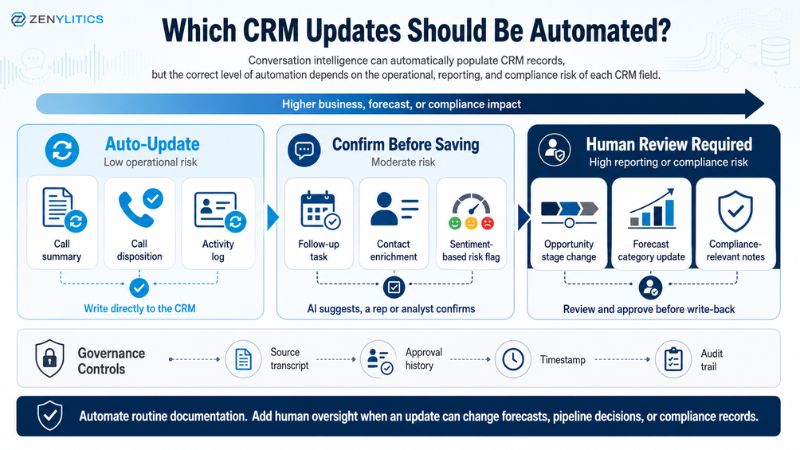
Conversation intelligence can automate routine CRM documentation, but updates that affect pipeline stages, forecasts, or compliance records should pass through human review and a traceable approval process.
What Can Make Conversation Intelligence Slow Teams Down
Weak CRM schema. If the CRM does not have fields that match what conversation intelligence extracts, the data has nowhere to go. Schema gaps force manual workarounds before the integration produces consistent output.
Inaccurate transcripts. Transcription quality degrades in noisy call environments or with poor audio compression. Inaccurate transcripts produce inaccurate extractions that are harder to correct than gaps in the first place.
Misread action items. AI extraction can confuse exploratory statements with firm commitments. A buyer who says “we might move forward in Q3” does not carry the same weight as one who says “we will sign in Q3.”
Too much automation without governance. Automating low-risk CRM updates reduces overhead. Automating high-stakes updates such as forecast category changes without human review creates audit exposure.
Missing recording consent governance. In jurisdictions requiring two-party or all-party consent for call recording, deploying conversation intelligence without a confirmed consent framework creates regulatory exposure that must be addressed before deployment.
Platform Evaluation Checklist for CRM Integration
Use this checklist when comparing conversation intelligence platforms on their CRM integration depth and governance capabilities.
| Evaluation Criteria | What to Confirm |
| CRM integration depth | Bidirectional sync or write-only; which CRM objects are supported |
| Capture method | CRM-native recording vs meeting bot; implications for data completeness |
| Custom CRM schema support | Whether the platform maps to organization-specific fields without custom development |
| Human review workflow | Whether analyst or manager approval is built in for sensitive field updates |
| Permissions and access controls | Who can view, edit, or override AI-generated CRM entries |
| Audit trail | Whether every automated update is logged with timestamp and source |
| Recording consent management | How the platform handles two-party and all-party consent requirements |
| Data retention policy | How long transcripts, extracted data, and write-back logs are retained |
| Measurement plan support | Whether the vendor helps define baseline metrics before deployment |
Human Review and Data Governance Considerations
Automated conversation intelligence outputs improve CRM accuracy substantially, but they do not eliminate the need for human oversight. AI-generated summaries can misattribute speaker intent, miss contextual nuance, or extract incorrect field values when conversation quality is poor.
In regulated industries including financial services, healthcare, and collections, organizations should establish a review layer for AI-generated CRM updates before they propagate to downstream reporting.
Data privacy requirements also apply to conversation intelligence integration. Call recordings, transcripts, and extracted insights are subject to the same retention, access control, and consent requirements as other customer interaction data. Before deploying conversation intelligence that writes to CRM records, organizations should confirm that their recording consent processes and data residency requirements cover AI-processed interaction data as well as the raw recordings.
FAQs
How does conversation intelligence improve CRM data accuracy?
Conversation intelligence transcribes customer interactions automatically and extracts structured data from those transcripts, which then populates CRM fields without manual input. This eliminates the omissions, delays, and summarization errors that occur when reps log calls from memory.
What CRM systems work with conversation intelligence platforms?
Most enterprise platforms support native integration with Salesforce and HubSpot, with additional support for other CRM environments depending on the vendor. Confirm bidirectional sync capability and custom field mapping support before deployment.
How much admin time can conversation intelligence save?
Time savings depend on call volume and how much manual logging currently occurs. Organizations with high-volume contact center operations typically see the largest reductions because every recorded interaction generates a structured record automatically.
What governance controls should contact centers apply to AI-generated CRM updates?
Contact centers in regulated industries should implement human review for AI-generated summaries and field updates before they finalize in the CRM. Recording consent processes should cover AI processing of interaction data, and access controls on transcript data should match those applied to raw recordings.
Does automated CRM data capture require existing speech analytics infrastructure?
Requirements vary by platform. Some conversation intelligence tools function as standalone systems. Others integrate with existing speech analytics platforms and write extracted insights into CRM records as an additional layer on top of existing infrastructure.