
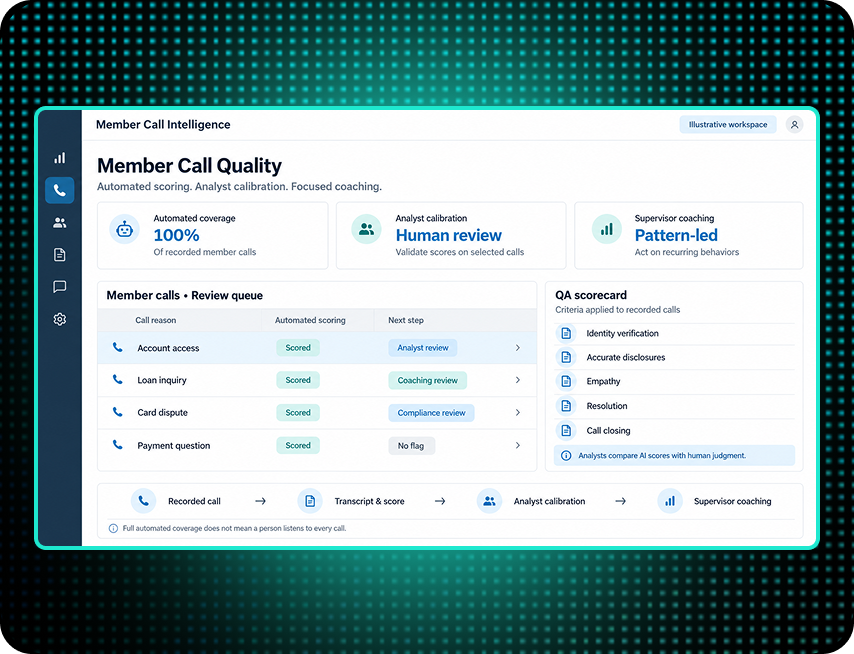
Credit unions monitor 100% of member calls by running every recorded call through speech analytics that transcribes it and scores it automatically against the QA scorecard, then having analysts calibrate those scores so supervisors coach from patterns instead of a handful of random calls. That matters because most credit unions still sample, and a Strategic Contact survey found that 57% of CUs review fewer than five calls per agent per month (2020 data).
Dort Financial Credit Union faced this limit directly. Its QA team could manually review about 4 calls per agent per month across roughly 50 to 60 agents. After the credit union moved to automated scoring across its active call population, with analyst-supported QA workflows, it reported $32,718 in annualized labor savings under its existing sampled QA policy, along with less manual QA time and a more consistent monitoring process. TheDort Financial Credit Union case study covers the full program.
Key numbers
- 57% of credit unions review fewer than 5 calls per agent per month, 7% review none, and only 43% meet the 5 to 10 call best practice (Strategic Contact, 2020 Credit Union Contact Center Survey).
- A large credit union’s QA team could monitor only 2% of calls (Level AI customer case).
- Verve Credit Union reviewed 5 calls per agent per month, saw some calls replayed 82 times, and later moved its member experience score from 4.31 to 4.70 (CallFinder case study).
- Advia Credit Union raised its quality score from 90% to 94.46% after moving beyond sampling (Five9 webinar).
- Contact centers rank as the top current or planned generative AI use case for credit unions, at 74% (Cornerstone, 2026).
- Dort Financial Credit Union reports $32,718 in annualized labor savings (Zenylitics case study).
How many calls should a credit union review per agent per month?
A credit union should review between 5 and 10 calls per agent per month, which is the common best-practice range. The Strategic Contact survey from 2020 found that 57% of credit unions fall below five calls, 7% review none, and only 43% reach the range.
Call sampling can control costs when a statistically sound method picks the calls. Even the best-practice range covers a small slice of an agent’s month, and the supervisor who scores those calls cannot judge how typical they are. The 5 to 10 range also reflects what listening time allows, because a human reviewer must hear each call in full. Coaching then rests on whichever conversations happened to land in the sample.
Coverage shrinks further at larger credit unions. A Level AI case describes one large credit union whose QA team could monitor only 2% of calls, which leaves 98 of every 100 member conversations unreviewed.
What is automated quality assurance in a credit union contact center?
Automated quality assurance is software that transcribes every recorded call and scores it against the credit union’s QA scorecard before any person listens. Speech analytics supplies the transcript and applies the scoring rules, and analysts calibrate those rules so the scores match how the credit union defines a good call.
Credit union scorecards typically cover identity verification, accurate disclosures, empathy, resolution, and call closing. The software scores each criterion against the transcript, and analysts review a sample of those scores to confirm each criterion works the way the QA team intends.
Automated quality management connects those scores to coaching and compliance review. Because every call receives a score, supervisors see patterns across the full call population, such as which behaviors lower scores and which topics members call about most.
| Sampled QA | Full call coverage | |
| Calls scored | A few per agent each month | Every recorded call |
| First listener | A human reviewer | Software, then analysts on selected calls |
| Coaching source | Individual calls from the sample | Patterns across the call population |
| Reviewer time | Spent listening and scoring | Spent calibrating and coaching |
The workflow runs in four steps, starting with the recorded call, then the transcript and automatic score, then analyst calibration, and ending with supervisor coaching from the patterns that appear.
Advia Credit Union raised its quality score from 90% to 94.46% after moving beyond sampling, according to a Five9 webinar.
Is random call sampling fair to agents?
Random sampling scores an agent on a few calls chosen by chance, so one unusually good or bad call can swing a month of results. Full coverage scores every agent on the same evidence, which makes comparisons between agents consistent.
Verve Credit Union shows how this looks in practice. Its team reviewed 5 calls per agent per month, and reviewers replayed some calls 82 times. After the credit union adopted automated scoring, its member experience score moved from 4.31 to 4.70.
Replaying a single call 82 times concentrates effort on one conversation while the rest of an agent’s calls go unscored. Scoring every call spreads that effort across the full month, so each score reflects typical behavior and supervisors can see which calls deserve a coaching conversation.
Transparency adds to the fairness case. When software scores every call, an agent can review the specific calls behind a score and raise a disagreement with evidence, and a supervisor can answer with the same transcript in hand. Sampled scores give the agent less to point to, since most of the month sits outside the review.
Do you still need human QA reviewers if AI scores every call?
Yes, a credit union still needs human QA staff, and their work shifts from listening and scoring to calibrating the scorecard and coaching agents.
After scoring, reviewers listen to the calls selected for coaching, compliance, or member experience issues, supervisors coach agents on the patterns that appear across many calls, and analysts update the scorecard when a product, policy, or regulation changes.
Calibration means analysts compare automated scores with human judgment on sample calls and adjust the rules until the two agree. A well-built QA scorecard gives that work a shared standard, since each criterion spells out what both the software and the analyst look for.
Dort Financial Credit Union reflects this shift, because its team moved off manual listening as the primary QA process. Zenylitics helped identify top call drivers, silence metrics, call avoidance signals, recap language issues, and investigative language opportunities, and the program supported UDAAP reporting, compliance review, and documentation of member service issues.
Overall, Zen has helped improve efficiency, reduce manual QA time, and create a more consistent monitoring process. (Dort Financial Credit Union)
How long does it take to move from manual QA to automated scoring?
A credit union can move to automated scoring in about four weeks when the software works on its existing call recording. Verve Credit Union deployed automated scoring in that time frame and kept its phone system as it was.
Preparation shortens the timeline. A credit union needs access to its call recordings, a current QA scorecard, a named owner for calibration decisions, and a coaching schedule that gives supervisors time to act on the first reports.
The sequence starts with connecting the existing recordings, then loading the QA scorecard into the scoring rules, then calibrating scores against analyst judgment, and ends with the first pattern reports for supervisors.
Teams without in-house analysts can hand setup and calibration to a managed provider. Guided Insights from Zenylitics connects to existing call data, runs the scoring, and has analysts validate findings before supervisors act on them.
Credit unions are moving in this direction. Contact centers rank as the top current or planned generative AI use case for credit unions at 74%, according to Cornerstone 2026 findings reported by CU Today.
Frequently Asked Questions
How many calls per agent should a credit union QA team review?
The common best-practice range is 5 to 10 calls per agent per month, and 57% of credit unions fall below five (Strategic Contact, 2020). Automated scoring removes that cap, so every call receives a score and humans review the calls marked for attention.
Does 100% monitoring mean someone listens to every call?
Software transcribes and scores every call, so people listen only to calls selected for coaching, compliance, or member experience issues. Analysts and supervisors spend their time on those calls instead of on random samples.
Do we still need QA staff?
Yes, QA staff remain essential, and their job shifts from listening and scoring to calibrating the scorecard and coaching. Dort’s team moved off manual listening as its primary QA process.
Is random sampling unfair to agents?
Random sampling can score an agent on a few unrepresentative calls, so full coverage is fairer because it scores every agent on the same evidence. A single unusual call carries less weight when all of an agent’s calls feed the score.
How fast can a CU switch?
Verve Credit Union deployed automated scoring in about four weeks on its existing call recording, without phone system changes. Zenylitics handles setup and calibration for credit unions that lack analyst capacity.
Sources
- Strategic Contact, 2020 Credit Union Contact Center Survey, Strategic Contact survey
- CallFinder, Verve Credit Union case study, Verve Credit Union
- Level AI, credit union case study, Level AI case
- Five9, Advia Credit Union webinar, Advia Credit Union
- CU Today, Cornerstone 2026 findings, Cornerstone 2026 findings