
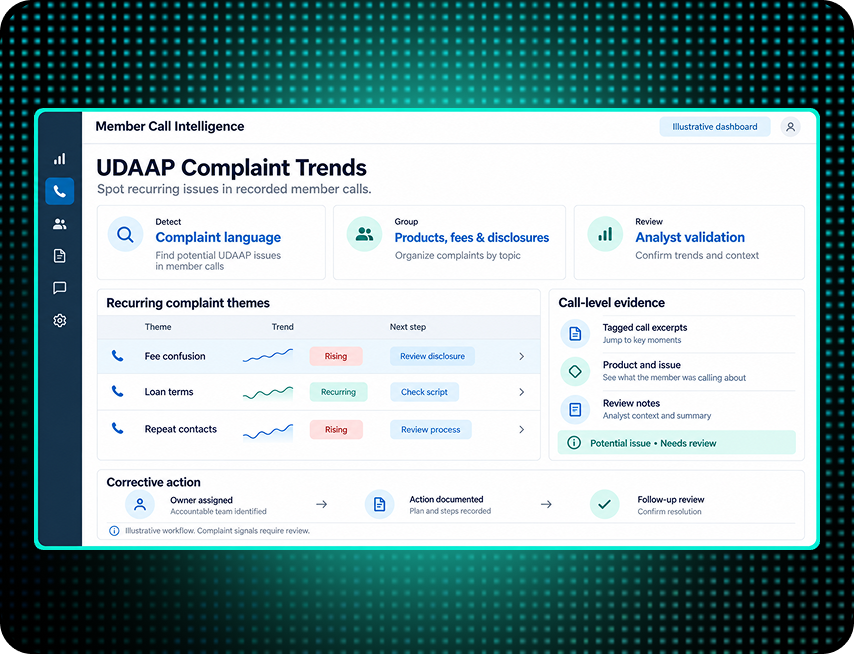
A credit union can find UDAAP complaint trends by using speech analytics to tag dissatisfaction and complaint language on every recorded call, then grouping those calls by product, fee or disclosure so repeat issues surface as a trend. NCUA’s UDAAP guidance treats many similar complaints about the same product as a warning sign, and examiners can request recorded calls and member complaint files. A call-level trend report works as an early warning and as documentation for exams.
Key numbers
- 60 calendar days. The time a credit union has to review and attempt resolution of a complaint after receiving it from the NCUA Consumer Assistance Center (MyCreditUnion.gov).
- 30 calendar days. The window a member has to dispute a credit union’s response in writing (MyCreditUnion.gov).
- 2 document requests. Scripts and recorded calls for telemarketing and collections, and member complaint files, both appear in NCUA’s UDAAP examination document list (NCUA).
- 15 days. How quickly companies generally respond to a complaint forwarded through the CFPB process, with some final responses taking 60 days (CFPB).
What are UDAAP violations at a credit union?
UDAAP violations are unfair, deceptive or abusive acts or practices that harm members. NCUA’s UDAAP compliance guide describes an unfair practice as one that causes or is likely to cause substantial injury to consumers. A deceptive practice involves a representation, omission, act or practice that misleads members, and an abusive practice materially interferes with a member’s ability to understand a term or condition.
The guide says these practices can cause significant financial injury to consumers. In a contact center, the exposure starts in everyday conversations, such as how an agent explains a fee, a loan term or a collections demand. Those explanations happen on recorded calls long before a member files a complaint.
Can member complaints signal a UDAAP problem?
Yes. NCUA says complaints may be one indication of UDAAP, and it says member complaints can indicate weaknesses in elements of the compliance management system, such as training, internal controls or monitoring. Complaints alleging that members did not understand the terms of a product or service deserve particular attention, especially when many members make similar complaints about the same product or service.
The guide adds that when members repeatedly complain about a product or service, examiners should mark the issue for possible further review. It also lists a high volume of charge-backs or refunds for a product or service as another area that could indicate potential UDAAP. A credit union that sees these patterns first can correct the cause before an examiner raises it.
What is complaint trend analysis?
Complaint trend analysis is the practice of grouping complaints over time by product, fee, disclosure or channel to find repeat issues. A team still resolves each complaint on its own, and it also counts how many members raised the same problem and how that number changes over time.
NCUA’s letter Improving the Process for Consumer Complaints tells credit unions to “evaluate complaint trends to identify and correct systematic compliance problems.” A trend turns scattered complaints into a finding about a script, a process or a disclosure, and the corrective action can then target the cause.
How can a credit union use call recordings to spot complaint trends?
A credit union can run speech analytics across every recorded call, tag complaint and dissatisfaction language, group the tagged calls by product, fee or disclosure, and review those groups on a fixed schedule. Automated quality management makes this possible across the full call population, well beyond a small sample.
- Tag complaint language on every call. Build categories for dissatisfaction, confusion about terms, fee disputes and repeated contacts about one issue.
- Group calls by product, fee and disclosure. Repeat issues surface as a trend once the same category appears across many calls.
- Compare week over week. A rising count points to a developing issue, and a single call tells much less.
- Review example calls. Analysts listen to calls from each group to confirm the pattern and remove false matches.
- Assign an owner and record the action. Document the corrective step, the person responsible and the date, so the credit union holds a record of what it found and what it did.
Category design decides the quality of the trend. Analysts build the complaint categories around the credit union’s own products, fees and disclosures, then calibrate them against reviewed calls so a category such as fee confusion captures the same issue week after week.
A complaint file holds the complaints that someone logged. Members can also voice dissatisfaction on calls that never reach that file, so a team reading only logged complaints sees a partial picture. That limitation is a form of survivorship bias, because the analysis covers only the cases that made it into the record.
What do NCUA examiners ask for when reviewing UDAAP?
NCUA’s UDAAP examination procedures open with a list of documents. Item 9 is “Scripts and recorded calls for telemarketing and collections,” item 11 covers “Agreements with affiliates and third parties that interact with consumers on behalf of the credit union,” and item 12 is “Member complaint files.” The procedures also test for a credit union process to respond to member complaints in a timely manner.
The same guide says call centers should respond effectively to members’ calls, and it applies that expectation to centers the credit union runs and to centers a third party runs. A call-level trend report speaks to these items because it ties complaint language in recorded calls to a product, a period and a corrective action.
Proof from our work. At Dort Financial Credit Union, the Zenylitics program supported UDAAP reporting, compliance review, and documentation of member service issues, using automated scoring across the active call population with analyst-supported QA workflows. The Dort Financial Credit Union case study describes the program.
Call-level evidence also answers the process questions in the procedures. A trend report shows that the credit union receives, monitors and responds to complaints, and it names the person who owns each correction.
Examiners decide what they request in each review, so a credit union should confirm current expectations with its examiner and counsel.
What should a monthly complaint-trend report include?
A monthly complaint-trend report should show complaint-language volume by product, fee and disclosure, the week-over-week change, example calls, and the owner of each corrective action. This is a recommended practice that goes beyond what regulation specifies.
| Report element | What it shows |
| Complaint-language volume | Number of calls tagged for each product, fee and disclosure |
| Week-over-week change | Which categories are rising, steady or falling |
| Example calls | Two or three recordings per category that confirm the pattern |
| Corrective action owner | Who fixes the script, process or disclosure, and by when |
Weekly counts feed the monthly view, so leaders see both the direction of each category and the month’s total.
Keep the report to one page. Leaders read a short report each month, and a short report gives examiners a consistent record to review.
Frequently asked questions
How long does a credit union have to respond to an NCUA-forwarded complaint?
A credit union has 60 calendar days after receiving a complaint from the NCUA Consumer Assistance Center to review it and attempt resolution. If the CAC receives no written response in that time, it begins a formal investigation. Members can dispute the response within 30 calendar days of the credit union’s letter.
Does a single complaint matter for UDAAP?
It can. NCUA’s guide says even a single substantive complaint may raise concerns that warrant further review. Repeated complaints about one product or service lead examiners to consider a closer look, so a credit union should resolve each complaint and also count how often the same issue appears.
Do complaints about third parties count?
Yes. NCUA’s guide tells examiners to consider complaints lodged against subsidiaries, affiliates and third parties acting on behalf of the credit union. The guide also covers call centers that a third party operates, so an outsourced call center falls within the scope of an examiner’s review.
What is the difference between complaint tracking software and call analytics?
Complaint tracking software logs the complaints that someone records. Call analytics finds complaint language in calls that nobody logged, which widens the data a credit union can review. The two work together, because tracking supplies the formal record and analytics supplies the call-level view.
How quickly do companies respond to CFPB-forwarded complaints?
The CFPB states that companies generally respond in 15 days, and in some cases provide a final response in 60 days. That process applies mainly to credit unions with more than $10 billion in assets. The 60 calendar days in the NCUA Consumer Assistance Center timeline covers complaints forwarded through that channel.
If your credit union records calls but reviews only the complaints members formally file, Guided Insights from Zenylitics can turn your recordings into a call-level complaint trend report. Talk to us about what that report would show for your products and fees.
This article is general information and not legal advice. Confirm your obligations with your counsel and your examiner.