

Conversation intelligence analyzes human-to-human interactions after or during the fact of surface patterns, compliance signals, sentiment, and coaching insights. Conversational AI facilitates real-time human-to-machine dialogue through chatbots, virtual assistants, and voice agents. The two technologies use overlapping infrastructure but serve different operational purposes.
The terminology gap between these two categories causes real procurement mistakes. A contact center leader researching speech analytics tools finds conversational AI platforms in the results. A revenue operations team evaluating meeting intelligence software encounters conversational AI vendors in the same category. Both terms use natural language processing and machine learning, both apply to business conversations, and both appear under the same AI umbrella in vendor marketing.
The functional distinction between them matters for buying decisions, technology stack planning, and understanding what each category can and cannot produce for a contact center operation.
Are Conversational Intelligence and Conversation Intelligence the Same?
Conversational intelligence and conversation intelligence are two distinct concepts that get used interchangeably often enough to create confusion, but they refer to different things.
Conversation intelligence refers to the technology and methodology used to analyze recorded or live business conversations, typically between agents and customers, to extract structured data including topics, sentiment, compliance language, behavioral patterns, and coaching signals.
Conversational intelligence, as a separate term, typically describes the broader cognitive and communicative capability that enables meaningful dialogue, whether in humans or machines. In a human context, it refers to the quality of interaction itself. In an AI context, it describes the sophistication of a system’s ability to understand and respond to natural language in real time.
For contact center and speech analytics purposes, conversation intelligence is the operationally relevant category. It refers to what platforms like CallMiner, Gong, and Zenylitics’ Guided Insights as a Service deliver: analyzed interaction data turned into findings that inform coaching, compliance, and business strategy.
What Is Conversational AI?
Conversational AI is a set of technologies that enables computers to engage in natural, two-way dialogue with humans through voice or text. Conversational AI participates in the interactions themselves, answering calls, chatting with customers, and assisting agents in real time by focusing on what is happening in the moment.
The underlying technology stack typically includes natural language processing to interpret intent, machine learning to improve responses over time, automatic speech recognition for voice-based interactions, and text-to-speech synthesis to deliver voice output that sounds natural.
Common enterprise deployments include IVR replacement systems that allow callers to describe their issue in plain language, AI-powered chatbots on web and messaging channels, virtual agents that handle transactional requests such as account lookups and appointment scheduling, and agent-assist tools that surface relevant information during live calls.
Is ChatGPT Conversational AI?
ChatGPT is a generative AI system and qualifies as conversational AI in the sense that it engages in natural, two-way dialogue. It uses large language models to understand input, maintain conversational context, and generate relevant responses. For business contact center purposes, however, ChatGPT is not a purpose-built conversational AI platform. Enterprise conversational AI deployments in contact centers typically require telephony integration, CRM connectivity, real-time low-latency response, and domain-specific training that general-purpose language models do not provide out of the box.
What Is a Conversation Intelligence Platform?
A conversation intelligence platform records, transcribes, and analyzes business conversations to produce structured findings that inform operational and strategic decisions. Conversation intelligence analyzes interactions during or after they occur, transcribing conversations, identifying topics and sentiment, flagging compliance risks, and surfacing patterns that inform coaching, routing, and workflow improvements.
In a contact center context, a conversation intelligence platform typically provides automated scoring against QA criteria, call transcription and search, sentiment analysis across the interaction population, top call driver categorization, agent coaching signals derived from behavioral patterns, and compliance monitoring for required language and prohibited phrasing.
The distinction from conversational AI is that a conversation intelligence platform does not engage with the customer directly. It works on the data that interactions produce, converting recorded conversations into analyzable, structured information.
Conversation Intelligence vs. Conversational AI: Side-by-Side
| Dimension | Conversation Intelligence | Conversational AI |
| Primary function | Analyze past or live interactions to extract insights | Engage in real-time dialogue with humans |
| Interaction role | Observer and analyst | Active participant |
| Timing | Post-call or real-time analysis | Real-time during the interaction |
| Output | Transcripts, scores, sentiment, patterns, coaching signals | Responses, task completions, resolutions |
| Primary users | QA teams, coaches, compliance, leadership | Customers, agents, support teams |
| Example tools | CallMiner, Gong, Zenylitics Guided Insights as a Service | IVR systems, chatbots, virtual agents, Siri, Alexa |
| Underlying tech | NLP, speech-to-text, machine learning, sentiment models | NLP, NLU, NLG, ASR, text-to-speech, dialogue management |
Is Conversation Intelligence the Same as Meeting Recording?
Conversation intelligence and meeting recording are not the same, though meeting recording is one data input that conversation intelligence platforms can process.
Meeting recording captures audio and sometimes video of a conversation. Conversation intelligence uses that recording as raw material, then applies transcription, topic detection, sentiment analysis, behavioral scoring, and pattern identification to produce structured findings from the recorded content.
A recording is a file. Conversation intelligence is the analytical process that makes the content of that file searchable, measurable, and actionable at scale across hundreds or thousands of interactions.
Can Conversation Intelligence Operate in Real Time?
Conversation intelligence can operate in real time, though the most common deployment in contact center environments is post-call analysis applied across the full interaction population. Real-time conversation intelligence uses live audio streams to flag compliance risks, surface coaching prompts, detect sentiment shifts, and alert supervisors to interactions requiring intervention as they occur.
Real-time deployment requires lower latency transcription and classification than post-call analysis and is typically prioritized for high-stakes interaction types such as collections calls with compliance exposure, financial services calls with mandatory disclosure requirements, or sales calls where in-the-moment coaching would affect conversion outcomes.
Does Conversational AI Use Sentiment Analysis?
Conversational AI systems can incorporate sentiment analysis, though the application differs from how sentiment analysis works in conversation intelligence platforms.
In conversational AI, sentiment detection is used to adjust the system’s real-time response. If a caller’s tone indicates frustration, the system may modify its response cadence, escalate to a human agent sooner, or adjust its scripted language. The purpose is to improve the immediate interaction experience.
In conversation intelligence, sentiment analysis is applied to a recorded or transcribed interaction to produce a scored output that contributes to trend analysis, coaching decisions, and aggregate performance monitoring. The purpose is to generate population-level insight, not to influence the individual interaction as it happens.
Are There Privacy Concerns With Conversation Intelligence and Conversational AI?
Both categories raise privacy considerations that organizations need to address before deployment. Security and privacy represent the third most commonly cited challenge when incorporating speech recognition and conversation intelligence capabilities, with 30.8 percent of respondents citing data privacy and security as a significant concern.
For conversation intelligence, the primary considerations are recording consent requirements, data retention policies, access controls on transcripts and scored interaction data, and whether extracted insights or AI-generated summaries are stored separately from raw recordings. In regulated industries such as financial services, healthcare, and debt collection, these requirements are governed by sector-specific rules alongside general data protection frameworks.
For conversational AI, the concerns center on what data the system collects during interactions, how that data is stored and used for model training, and whether customers are informed that they are engaging with an automated system rather than a human agent. Transparency about AI participation in a conversation is increasingly a regulatory expectation rather than a best practice in several jurisdictions.
Organizations deploying either technology should confirm recording consent requirements for their operating jurisdictions, define retention and deletion schedules for interaction data, restrict access to sensitive interaction content, and document how AI-generated outputs are reviewed before use in employment-related decisions such as agent coaching and performance management.
Can Conversation Intelligence and Conversational AI Work Together?
The two categories are complementary and often deployed in combination within the same contact center environment. If conversation intelligence reveals a spike in password reset calls, a conversational AI solution can automate those requests going forward.
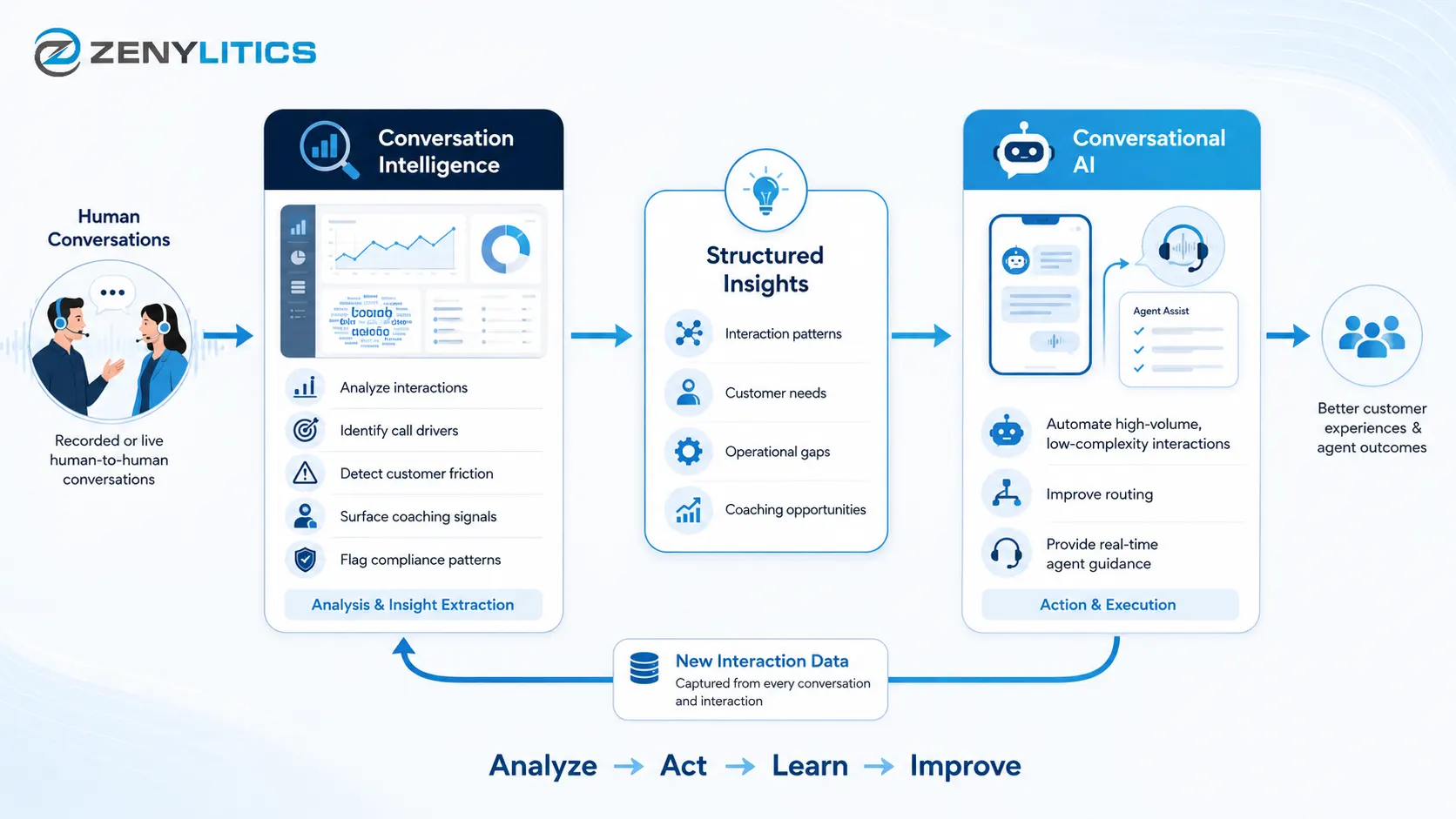
Conversation intelligence analyzes interactions; conversational AI acts on the insights
Conversation intelligence surfaces what is happening across the interaction population: which call types generate the most volume, where agent language gaps create compliance risk, which behavioral patterns distinguish high-performing agents from the rest, and where customer friction is concentrated. Conversational AI acts on those findings by automating high-volume, low-complexity interactions, routing customers more accurately, and providing agents with real-time guidance during live calls.
The feedback loop between the two is what makes them valuable together. Conversation intelligence provides the analytical foundation that makes conversational AI deployment decisions better-informed, and conversational AI creates new interaction data that conversation intelligence platforms can analyze to continue improving the program.
For organizations operating managed speech analytics programs, conversation intelligence is typically the foundational layer. It produces the structured findings that inform both operational coaching decisions and the design of any conversational AI tools deployed on top of the same call infrastructure.
FAQs
Are conversational intelligence and conversation intelligence the same?
They are not the same. Conversation intelligence refers to the technology used to analyze recorded or live business conversations and extract structured data from them. Conversational intelligence typically refers to the broader capability, in humans or machines, to engage in meaningful dialogue. In contact center and speech analytics contexts, conversation intelligence is the operationally relevant term.
Is ChatGPT conversational AI?
ChatGPT qualifies as conversational AI in that it conducts natural two-way dialogue. For enterprise contact center deployment, it is not a purpose-built platform. Contact center conversational AI requires telephony integration, real-time low-latency performance, CRM connectivity, and domain-specific training that general-purpose language models do not provide as standard.
What is an example of conversational AI?
Common enterprise examples include IVR replacement systems that process natural language from callers, AI-powered chatbots on web and messaging channels, virtual agents that complete transactional requests without human involvement, and agent-assist tools that surface information to agents during live customer interactions.
What is a conversation intelligence platform?
A conversation intelligence platform records, transcribes, and analyzes business conversations to produce scored outputs, behavioral patterns, sentiment data, compliance flags, and coaching signals. It does not engage with the customer directly. It works on the data that interactions generate to produce structured findings for QA teams, coaches, compliance functions, and leadership.
Is conversation intelligence the same as meeting recording?
Meeting recording captures audio or video content. Conversation intelligence applies transcription, topic detection, sentiment analysis, and behavioral scoring to that recorded content to produce actionable findings. A recording is a file; conversation intelligence is the analytical process that makes the content of that file searchable and measurable at scale.