
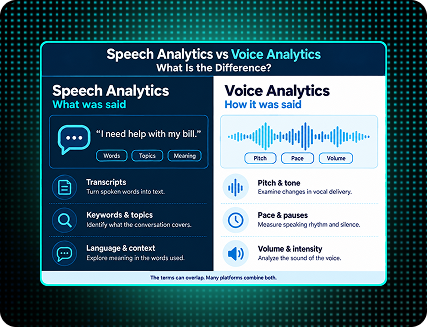
Speech analytics looks at what a customer and agent actually said. Voice analytics looks at how they said it, the pace, pitch, volume, and pauses in the audio itself. That split sounds tidy until you check a vendor’s product page. Many platforms fold acoustic measurement into “speech analytics,” and some “voice analytics” tools handle transcription too. This article compares the inputs, outputs, and limits of each approach, then walks through how a contact center should evaluate both before choosing where to invest.
What Is the Difference Between Speech Analytics and Voice Analytics?
At the core, speech analytics works from language. It converts a call into a searchable transcript through automatic speech recognition, then flags phrases, topics, and call drivers. Voice analytics works from sound. It measures acoustic properties like speaking rate, pitch, and silence rather than word content.
The catch is that vendor naming isn’t standardized. A platform labeled “speech analytics” may already score tone and pace, while one labeled “voice analytics” may include a full transcript engine. Treat these as two analytical layers a product can offer, not two fixed product categories.
| Dimension | Transcript / Linguistic Analysis | Acoustic / Vocal Analysis |
| Question answered | What language was used and in what context? | How did the audio sound and change? |
| Input | Audio converted to searchable text | Audio features including pace, pitch, volume, and pauses |
| Example evidence | A required phrase appears in the transcript | The speaker’s pace shifts around that phrase |
| Limit | Recognition or context errors can affect a phrase flag | A sound pattern alone doesn’t establish emotion or intent |
What Does Speech Analytics Measure in a Contact Center?
Speech analytics starts with a recorded or live call, converts the audio to text, then applies language analysis to that transcript. These surfaces required phrases, disclosure language, topic categories, and call-driver trends across large call volumes. A QA team might flag every call where a compliance disclosure phrase is missing, or track how often billing complaints mention a specific product change.
The limit matters here. A detected phrase confirms that specific words appeared. It doesn’t confirm the full interaction met a regulatory standard on its own, context and a human reviewer still decides that. Worth noting: Zenylitics’s own published definition of speech analytics already includes acoustic signals like tone and pitch alongside language analysis, so the line between the two categories isn’t always where a reader expects.
How Does a Transcript Become a QA Signal?
The path runs from recording to automatic transcription, then a category or phrase rule flags the call, a sampled portion goes to human review, and only then does a finding become a coaching or compliance action.
What Does Voice Analytics Measure in a Contact Center?
Voice analytics measures what’s audible in the recording rather than what’s spoken. That includes pace, pitch, volume, pauses, and moments where speakers talk over each other. These are observable acoustic features, measurable the same way a sound engineer measures them.
Separating measurement from interpretation is the important part. If a transcript shows a customer saying “I’m fine” followed by a long pause and a drop in pace, that pattern might deserve a second look from a reviewer. It doesn’t prove the customer was frustrated. Research on inferring emotion from vocal cues points to real uncertainty in mapping acoustic signals to emotional states, partly because human listeners themselves often disagree on what a given tone means. Some vendors also use “voice analytics” to describe a bundle that includes linguistic analysis, so check what a specific product actually measures before assuming.
Where Do Speech and Voice Analytics Overlap?
The overlap is bigger than the “what vs. how” framing suggests. Modern platforms increasingly combine language analysis and acoustic measurement in one workflow, and some vendors use “speech analytics” as an umbrella term for the whole voice-interaction pipeline. Sentiment scoring is a clear example. A sentiment label can draw on word choice, vocal prosody, or both, depending on the product, so it’s worth checking a vendor’s feature list rather than assuming.
Zenylitics covers this same boundary in more depth in its conversation intelligence comparison, which looks at how conversation intelligence extends across channels and actions beyond a single call.
Which Contact Center Use Cases Benefit From Each Approach?
The right evidence stream depends on the question being asked. Word-based evidence and sound-based evidence answer different things, and mixing them up leads to weak conclusions.
When Do the Words Matter Most?
Compliance phrase review, identifying call reasons, tracking objections, and spotting recurring complaint language all depend on transcript accuracy. A QA rubric built around required disclosures or prohibited language needs the transcript to be the primary evidence, with a reviewer checking context around any flagged phrase.
When Do Vocal Cues Add Context?
Pauses, pace changes, and interruptions are useful for escalation triage, flagging calls that may need faster review. Treat any inferred stress or satisfaction signal as a cue, not a conclusion. A QA reviewer still needs to listen to the full exchange before acting on it.
How Should a Team Evaluate Both Capabilities?
A structured evaluation avoids buying features that sound good on a demo and turn out unreliable in production. Work through these decisions in order.
- Define the business question and who owns the answer.
- Confirm which channels are covered and whether the data is recorded, live, or both.
- Test transcript performance against your actual call audio, including accent and background noise.
- Confirm which acoustic features the platform actually exposes, not just what the marketing page lists.
- Calibrate flags against human-reviewed calls and track the false positive rate.
- Review data access, retention, and compliance requirements before rollout.
- Confirm where findings land, QA, coaching, CRM, or a leadership report, and who acts on them.
A simple buyer checklist helps keep vendor conversations grounded: for each capability claimed, ask what proof the vendor can show, and name the person on your team who will validate it before it’s trusted. Be cautious of any accuracy, lift, or ROI figure a vendor quotes without a source specific to your environment.
How Does Zenylitics Turn Call Analysis Into Decisions?
Zenylitics doesn’t sell a standalone voice analytics tool. The firm connects to a contact center’s existing interaction data, designs the category taxonomy and scorecards around specific business questions, calibrates the analysis against real calls, and delivers analyst-reviewed findings formatted for leadership through Guided Insights as a Service. The value is in operating and interpreting the analytics consistently, not in a separately verified acoustic feature set. Discuss your goals if you’re weighing how speech and voice analysis should fit into that kind of program.
What Else Should Teams Know About Speech and Voice Analytics?
Can Speech Analytics Work in Real Time?
Yes. Streaming speech recognition exists and is documented by major providers, but whether a specific deployment runs live or in batch depends on the integration a vendor sets up, not on the category label alone.
Can Vocal Cues Prove a Customer Is Upset?
No. A pitch or pace change is a measurable signal, not a confirmed emotional state. Reliable use requires a human reviewer checking the full call in context before any action follows from it.
Is Voice Analytics the Same as Voice Biometrics?
No. This article covers interaction analysis, meaning what a call reveals about content and delivery. Voice biometrics is a separate identity-verification technology and falls outside this comparison.
Is Conversation Intelligence Broader Than Speech Analytics?
On Zenylitics’s site, yes. Conversation intelligence generally spans multiple channels and connects findings to coaching, compliance, and CX decisions. See the broader comparison for the full distinction.
Choose the evidence stream that actually answers your operational question, transcript for what was said, acoustic signal for how it was delivered. Judge any vendor by what it demonstrates on your own calls, not by which label it uses. Human review and a defined next action are what turn either signal into something a team can use.