
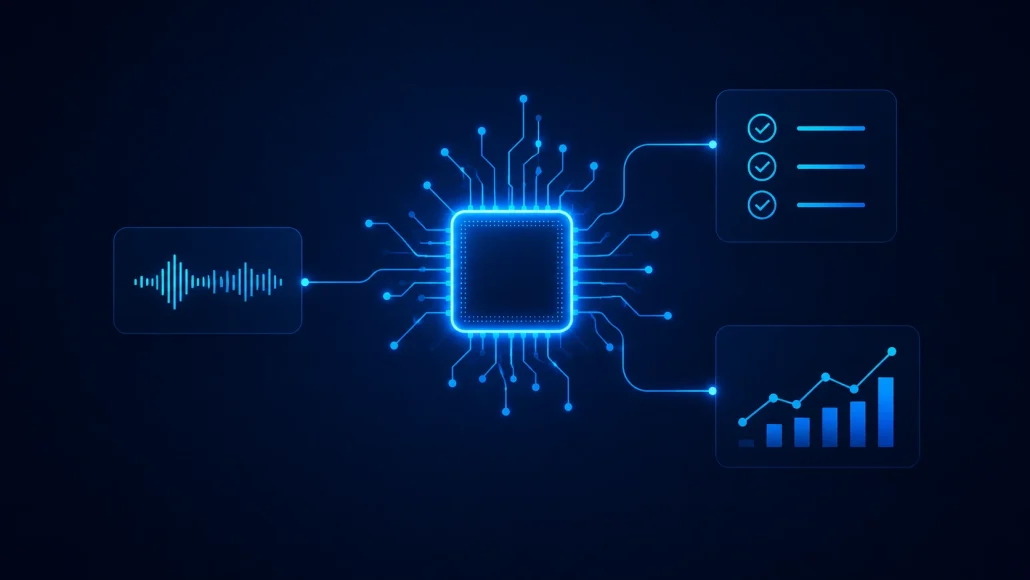
Automated quality management (AQM) uses AI to score contact center conversations against a defined QA scorecard, replacing or supplementing manual call sampling with analysis across 100 percent of interactions. The system captures interaction data, generates a transcript, extracts relevant signals, applies scoring criteria, and routes scored findings into coaching, compliance, and operational workflows.
Quick answer
Automated quality management (AQM) uses AI to score contact center conversations against a defined QA scorecard across 100 percent of interactions, instead of a small manual sample. The system captures interaction data, generates a transcript, extracts signals, applies scoring criteria, and routes findings into coaching, compliance, and operational workflows.
Key takeaways
- 73 percent of contact centers still rely on sample-based monitoring that reviews just 2 to 5 percent of interactions.
- Transcription accuracy is the single largest variable in AI scoring reliability, followed by taxonomy precision.
- Human judgment remains necessary for interpretive criteria, disputed scores, and employment-related decisions.
73 percent of contact centers still rely on sample-based quality monitoring, reviewing just 2 to 5 percent of total interactions. The remaining 95 to 98 percent of conversations are invisible to QA teams. AQM closes that gap without requiring a proportional increase in QA headcount.
What Is Automated Quality Management and Why Do Contact Centers Use It?
Automated quality management is the application of AI to the evaluation of contact center conversations at scale. Where manual QA requires a human reviewer to listen to each call, score it, and document the result, AQM automates the listening, transcription, extraction, and scoring steps so that QA coverage extends across the full interaction population rather than a sampled fraction of it.
Contact centers use AQM to expand coverage, reduce the cost of QA per interaction, surface compliance risks earlier, and generate consistent coaching data across all agents rather than the subset whose calls were selected for manual review. AQM is one part of contact center conversation intelligence, which also covers compliance language, customer sentiment and call drivers.
How AQM Differs From Automated Call Scoring and AI Quality Assurance
These terms are often used interchangeably but describe different scopes:
- Automated call scoring refers specifically to the act of generating a numerical score for an interaction without human listening
- AI quality assurance describes the broader use of AI to support or replace QA reviewer tasks
- Automated quality management is the complete operational system: scoring, routing, calibration, exception handling, and workflow integration
AQM is the program. Automated call scoring is one capability within it.
Why Manual-Only Quality Monitoring Leaves Visibility Gaps
Manual QA at typical staffing ratios covers 1 to 2 percent of interactions. That coverage rate makes several categories of operational intelligence structurally invisible: behavioral patterns distributed across hundreds of agent interactions, compliance risks that occur outside the reviewed sample, call driver trends that only emerge at volume, and performance differences between agents that require population-level data to detect reliably. Where full coverage is not yet practical, a structured approach to speech analytics call sampling can narrow some of these gaps, though not all of them.
What AQM Can Evaluate Across Contact Center Channels
- Voice calls: transcription-based scoring with acoustic signal support
- Chat and messaging: text-based scoring without transcription
- Email: message-level scoring against content and process criteria
- Virtual agents and bots: interaction log scoring against containment, resolution, and experience criteria
- Screen recording: combined voice and visual evaluation where available
How Does AI Score a Contact Center Conversation?
Capture and Organize the Interaction Data
The system collects the call recording or interaction log along with associated metadata: agent ID, queue, channel, duration, date, and any available CRM or case context.
Convert Voice Into a Structured Transcript
Automatic speech recognition converts audio into a timestamped, speaker-labeled text transcript. Transcription accuracy depends on audio quality, accent coverage, noise levels, and channel separation.
Extract Conversation Signals and Events
Natural language processing identifies keywords, topics, sentiment shifts, required phrases, prohibited language, silence patterns, and other defined signals relevant to the QA scorecard.
Apply the Relevant QA Scorecard
The system matches the interaction to the correct scorecard based on channel, queue, interaction type, or defined routing rules. Each scorecard criterion is evaluated against the extracted signals and transcript content.
Generate Criterion-Level Answers and a Final Score
Each question on the scorecard receives an answer (yes, no, partial, or not applicable), a confidence indication, and evidence in the form of a transcript excerpt or signal reference. The final score is calculated from criterion-level results according to defined weights and critical failure rules.
Route Scores, Evidence, and Exceptions Into Workflows
Completed evaluations route to QA review queues, coaching systems, compliance escalation paths, or CRM records based on score thresholds, exception rules, or defined routing logic.
How Rule-Based and Generative AI Scoring Differ
| Dimension | Rule-Based Scoring | Generative AI Scoring |
| Method | Keyword detection, phrase matching, structured logic | LLM-based comprehension and evaluation |
| Strengths | Predictable, auditable, low false-positive risk | Handles interpretive criteria, nuanced language |
| Limitations | Misses context, requires keyword maintenance | Higher false-positive risk, less auditable |
| Best use | Compliance phrase checks, required disclosures | Service quality, tone, conversational judgment |
Most production AQM systems combine both approaches, using rule-based logic for compliance criteria and generative AI for interpretive quality criteria.
How Do QA Scorecards Define What Good Service Looks Like?
Scorecard Questions, Instructions, Answers, and Thresholds
Each scorecard criterion contains a question, evaluator instructions, allowed answer types, and a pass threshold. Instructions must be specific enough that two evaluators presented with the same interaction would answer consistently.
Objective Criteria and Interpretive Criteria
Objective criteria have a verifiable correct answer: did the agent state the required disclosure? Interpretive criteria require judgment: did the agent demonstrate active listening? AQM handles objective criteria reliably. Interpretive criteria require calibration and human review validation.
How Weights and Critical Failures Affect the Score
Criteria can carry different weights based on operational priority. A critical failure criterion, such as a missing compliance disclosure, can automatically fail the full interaction regardless of performance on other criteria.
Why Scorecards Should Change by Channel
A voice call scorecard that evaluates tone, pace, and verbal confirmation does not transfer directly to a chat channel where those signals do not exist. Each channel requires criteria appropriate to its interaction type and communication medium. For a step-by-step walkthrough with an example and a template, see how to build a QA scorecard.
Worked Example of AI Scoring a Contact Center Conversation
A collections agent handles an inbound payment call. The AQM system transcribes the interaction, detects that the agent confirmed the account holder’s identity (pass), stated the required payment amount accurately (pass), offered a payment plan (pass), and did not obtain verbal agreement before proceeding (fail, critical). The critical failure triggers an automatic compliance review flag and routes the interaction to the compliance queue with transcript evidence attached.
How Accurate and Reliable Is AI Call Scoring?
What Affects AI Scoring Reliability?
- Transcription accuracy is the single largest variable. Poor audio quality degrades every downstream scoring step
- Taxonomy precision: vague or overlapping scorecard criteria produce inconsistent results regardless of AI sophistication
- Training data relevance: models calibrated on data from different industries or interaction types perform less reliably
How Calibration Compares AI and Human Evaluations
Calibration is the process of comparing AI scoring outputs against agreed human-reviewed reference interactions. Disagreement analysis identifies which criteria the AI misinterprets, which triggers a scorecard revision or model adjustment. Calibration should repeat after any material change to the scorecard, the agent population, or the product being discussed.
Evidence, Explainability, and Score Disputes
Every AI-generated score should be accompanied by the transcript excerpt or signal that produced each criterion answer. Agents and supervisors must be able to review that evidence when a score is disputed. A score that cannot be explained or evidenced undermines program trust.
What Happens When an Evaluation Cannot Be Completed?
Incomplete audio, failed transcription, or interactions outside the scorecard’s defined scope should be flagged as incomplete rather than scored with low confidence. Incomplete interactions should route to human review. Calibrating AI scores against human review is also a core step in our conversation intelligence implementation checklist.
How Do Automated Quality Management and Human Review Work Together?
What AI Can Handle at Scale
- Objective criterion scoring across 100 percent of interaction volume
- Automated compliance phrase detection and flagging
- Exception routing based on score thresholds
- Trend analysis and pattern identification across the full population
Where Human Judgment Remains Necessary
- Interpretive criteria requiring contextual understanding
- Disputed score resolution
- High-stakes decisions such as disciplinary action or compensation reviews
- Any finding used in employment-related decisions
Who Owns Scorecard Updates and Recalibration?
A named QA lead or analytics owner must own every scorecard version, maintain version history, and authorize changes. Uncontrolled scorecard changes invalidate historical comparisons and make calibration results meaningless.
How Does AQM Turn Scores Into Compliance, Coaching, and Operational Action?
How AQM Identifies Potential Compliance Risks
Scored interactions that trigger compliance criteria route automatically to a compliance review queue with evidence attached. Reviewers confirm or dismiss the flag, document the outcome, and escalate when required.
How Scores Identify Coaching Opportunities
Pattern analysis across multiple scored interactions identifies which agents score below threshold on which criteria consistently. Coaching grounded in pattern data across 30 calls is more defensible and more actionable than coaching based on a single manually reviewed call.
How Individual Scores Become Leadership-Level Findings
Individual scores aggregate into team trends, queue performance, and program health metrics. Leadership reporting should answer five questions: what changed in the data, what caused it, why it matters, what response is appropriate, and how success will be measured.
How Zenylitics Connects Automated Scores to Operational Action
Guided Insights as a Service from Zenylitics pairs automated scoring with analyst review, scorecard calibration, and structured delivery of findings to QA teams and leadership. Rather than leaving contact centers to interpret automated outputs independently, Zenylitics provides the operational layer that converts scores into coaching actions, compliance documentation, and leadership-ready reporting. For organizations whose AQM outputs need to reach executive leadership on a defined schedule, Dossier delivers statistically validated briefings as email, audio, and video without requiring dashboard access.
Request a Conversation Analytics Assessment
Frequently Asked Questions
How Is Customer Data Protected During Automated Conversation Scoring?
Agent identifiers and customer personally identifiable information should be removed before any data enters AI processing layers. Access controls, retention schedules, and data residency requirements apply to transcripts, scores, and interaction summaries at the same level as the underlying recordings.
Does Every Eligible Interaction Receive a Valid Quality Score?
No. Incomplete audio, failed transcription, interactions outside the defined scope, and edge cases that fall outside scorecard criteria should be flagged as incomplete and routed to human review rather than scored with low confidence.
Can AQM Evaluate Virtual Agents and Self-Service Interactions?
Yes, when interaction logs are available in a format the AQM system can process. Scoring criteria for virtual agents differ from human agent criteria and require separate scorecard design covering containment rate, resolution accuracy, escalation handling, and interaction quality.
How Long Does It Take to Implement Automated Quality Management?
Implementation timelines depend on data readiness, integration complexity, scorecard design, and calibration requirements. A focused pilot on one channel with one use case can produce first scored outputs within 30 to 60 days. A fully calibrated, multi-channel program typically requires 90 to 120 days to reach reliable operational use.
Can you trust automated QA scoring?
Reliability depends on transcription accuracy, precise scorecard criteria, and relevant training data. Calibration compares AI scores against human-reviewed reference interactions, and disagreements trigger scorecard revisions, so trust is earned through ongoing calibration.
What is the difference between automated quality management and manual QA?
Manual QA at typical staffing ratios covers 1 to 2 percent of interactions. AQM applies objective scoring criteria across 100 percent of interaction volume, with human reviewers focused on interpretive criteria and disputed scores.
Does automated quality management replace QA analysts?
No. AI handles objective scoring, compliance phrase detection, exception routing, and trend analysis at scale, while people handle interpretive criteria, disputed scores, and high-stakes decisions, and a named QA lead owns scorecard versions and recalibration.