
Industry: Consumer finance
Challenge: Top-performing sales behaviors existed but could not be identified or taught
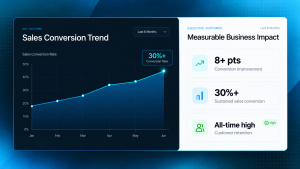
Result: More than 8 points of conversion improvement, to a sustained rate above 30%
Company Overview
The client is a US consumer-finance sales organization operating a high-volume outbound sales floor. Representatives handle consumer-finance sales conversations where conversion depends on discovery, objection handling, and close technique across thousands of monthly calls. Leadership’s objective was direct. They wanted the floor’s average performance to move closer to what the organization’s strongest representatives were already achieving, rather than accepting a permanent gap between top and middle performers.
The Challenge
Two representatives consistently closed more deals than the rest of the floor, month after month. Sales leadership could see the gap in weekly reporting, and everyone on the team knew who the top closers were, but nobody could describe with any precision what those representatives were actually doing differently on a live call. Coaching sessions leaned on general encouragement, phrases like “build more rapport” or “handle objections better,” because there was no documented, specific technique behind the results. A skill that cannot be named cannot be taught, and that missing piece sat at the center of the organization’s coaching problem.
Why the Existing Approach Failed
Manual call listening could not close this shortfall at the volume this floor generated. A sales manager might catch a strong save on one call during a spot check, but recognizing a pattern requires comparing that behavior against dozens or hundreds of other calls, not one isolated example. Without that comparison, a manager had no reliable way to confirm whether a technique they noticed was actually driving the outcome, or whether it simply happened to appear on a call that closed for other reasons. Dashboards summarizing call volume and close rates told leadership that a performance difference existed. They did nothing to explain why it existed, which meant the organization was measuring the problem without any path toward fixing it.
The Zenylitics Approach
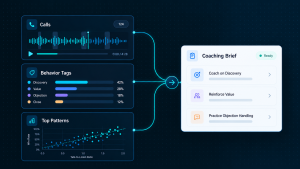
Data Layer. Recorded sales calls and full transcripts across the outbound floor, covering every representative rather than a manually selected sample.
Analytics Layer. Behavior-tagged scorecards built around objection types, rebuttal language, and close technique, applied consistently across every analyzed call so that behaviors could be compared on equal terms.
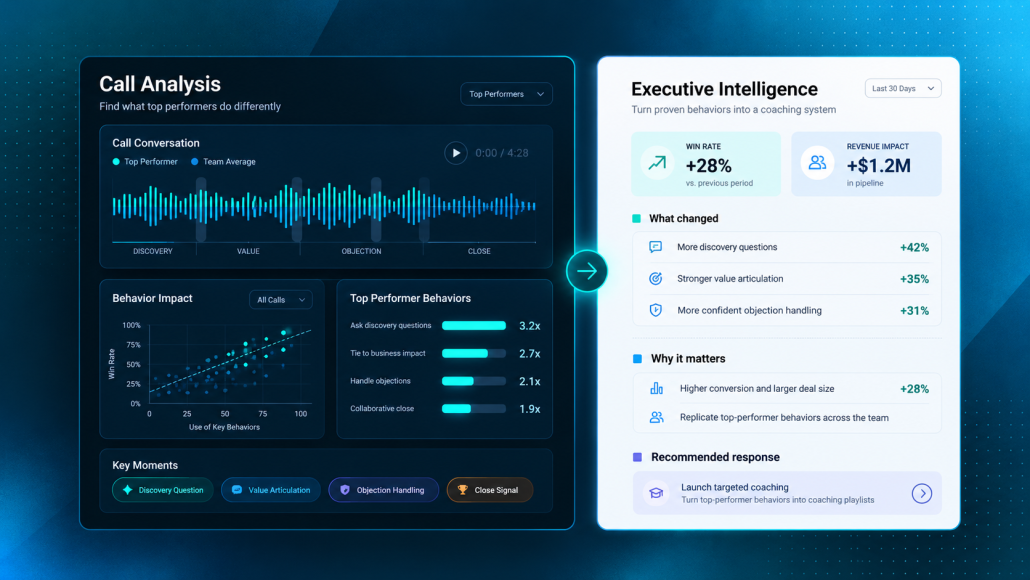
Human Intelligence Layer. Zenylitics analysts modeled the language patterns of the organization’s two highest-converting representatives, then ran a statistical correlation between specific behaviors and close outcomes. This step matters on its own. Modeling top performers only tells you what they do. Correlating those behaviors against actual close outcomes is what confirms a pattern is actually driving results, rather than simply appearing alongside them by coincidence. Without that second step, a coaching program risks teaching representatives to imitate a habit that never mattered in the first place.
Action Layer. The confirmed behaviors were packaged into a coaching artifact managers could use directly in one-on-one sessions, rather than a research summary that still required someone to translate it into something teachable.
Key Insights Discovered
Modeling the top two closers surfaced four specific, repeatable behaviors tied to conversion, not a general description of “good selling” or “strong rapport.” Each behavior was defined precisely enough that a manager could listen for it on a live call and recognize it immediately. Behaviors in this category typically fall into the same handful of buckets Zenylitics tracks across conversion-focused engagements, how closely a representative matches their rebuttal to the specific objection a prospect raises rather than reaching for a generic response, how many probing discovery questions get asked before a solution is pitched, whether the representative locks a concrete next-contact commitment before the call ends, and how an upsell gets introduced once the primary need is confirmed.
Rather than fold these advanced techniques into the floor’s existing basics scorecard, Zenylitics built them into a second-tier expert-skills scorecard. This distinction was deliberate. Strong representatives tend to sell in a more free-flowing, adaptive style, while representatives still developing their fundamentals benefit from sticking closer to a defined script. Blending the two skill levels into one scorecard risked confusing day-to-day coaching for representatives who were not ready for the advanced material yet. Separating the two scorecards also created something the original coaching process never had, a way to measure adoption over time. A representative’s progress through the expert-skills behaviors could now be tracked per person, which meant the organization could see whether coaching was actually changing behavior rather than simply hoping it was.
Business Outcomes
According to the organization’s Chief Executive, the engagement produced a sustained improvement of more than 8 points in front-end sales conversion, moving the floor’s overall conversion rate to above 30 percent. The organization also reported an all-time high in back-end client retention on its servicing book over the same period, and noted that this result came after evaluating more than 10 competing speech-analytics vendors before selecting Zenylitics.
These figures come from the client directly, reported in a testimonial roughly seven months into an engagement that continued for several years afterward. They reflect the organization’s own account of early impact, not a Zenylitics-instrumented measurement, and Zenylitics does not hold the baseline data behind them. That distinction matters for how the numbers should be read. An 8-point improvement reported seven months into a multi-year program captures meaningful early momentum. It is not necessarily the full or final impact of the engagement, and presenting it as a ceiling would overstate what the data can actually support.
If your team is at the same stage, our guide to evaluating conversation intelligence vendors lists the questions and proof to ask for.
Client Quote
“The most impressive improvement was in our front-end sales conversion and back-end client retention. We have had over an 8% conversion improvement, and it now stands over a 30% sales conversion rate. And our retention rate is at an all-time high.”
Chief Executive Officer, client organization
Why This Matters
A sales floor’s strongest performers almost always carry knowledge nobody has written down. That knowledge sits in specific word choices, specific sequencing, specific ways of handling an objection in the first ten seconds after it’s raised, and none of it transfers to the rest of the team by itself. Conversation intelligence creates value at the exact point where that tacit skill gets identified, tested against actual outcomes to confirm it works, and turned into something concrete enough for a manager to coach against in a fifteen-minute session.
That third step is the one organizations most often skip. Plenty of contact centers can point to a top performer and say, correctly, that they’re good at their job. Far fewer can say precisely what that person does differently, prove it moves the numbers, and hand that proof to every other representative on the floor. The distance between those two positions, knowing someone is good versus knowing exactly why, is what separates a report from a coaching system. For this organization, closing that distance meant turning two representatives’ individual skill into a documented, trackable capability the whole floor could build toward. Results reported by the client and measured against a known starting point are the kind of evidence that matters most when proving conversation intelligence ROI.