
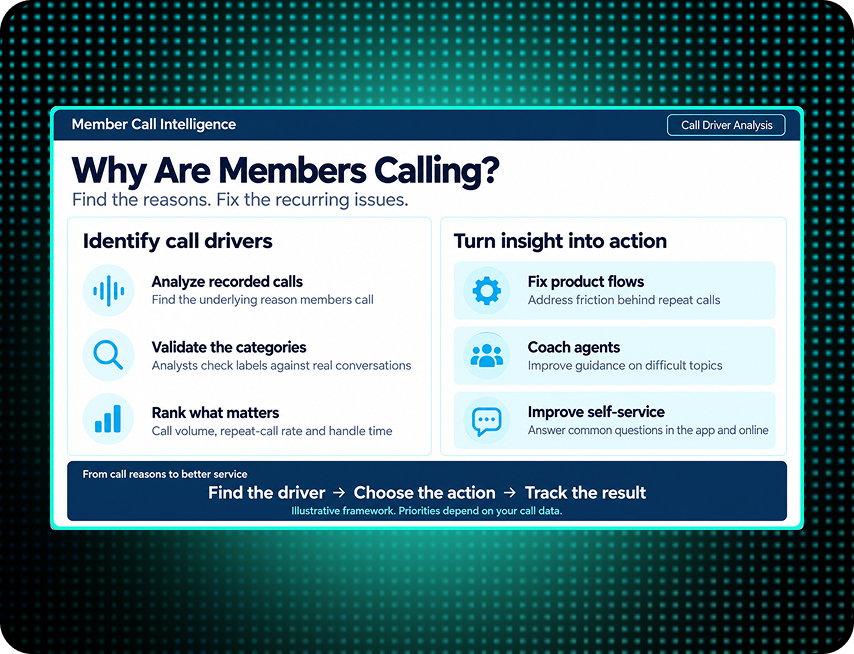
A credit union finds its top call drivers by having speech analytics categorize every recorded call by the underlying reason the member called, such as a card decline, a mobile deposit or a transfer, then ranking those reasons by volume, repeat-call rate and handle time. Unitus Community Credit Union used this approach, found far more mobile-deposit calls than it expected, and cut those calls by 35% after fixing the experience. The ranking shows which calls to prevent, which to coach and which to turn into self-service content.
Key numbers
- 35% fewer mobile-deposit calls at Unitus Community Credit Union in July 2020, after it fixed the mobile-deposit experience (CreditUnions.com).
- About 33 hours of total talk time saved by that reduction, for employees and members combined (CreditUnions.com).
- 5 reasons that typically top a credit union’s call list, namely balances, transaction history, ACH deposits, transfers and card inquiries (CUSO Magazine).
- 10% more chat and self-service adoption at BCU over one year, after it used call reasons to train its chatbot (Capacity).
- 10% contact-center attrition at BCU against an industry average close to 40%, as reported in the same case study (Capacity).
- 30% of disposition codes selected correctly in one contact center, an estimate from an unnamed EvaluAgent client (EvaluAgent).
Why do disposition codes fail to show why members call?
A disposition code records the label an agent picked after the call, and that label often misses the underlying reason. EvaluAgent’s analysis of disposition codes and call reasons explains that code lists stay short to limit agent fatigue, so agents choose the closest option, and some select the first item in the menu when time is short. A label such as a billing issue also covers too many situations to show what the member needed.
A call driver is the underlying reason the member called, such as a card decline. Speech analytics assigns it from what the member and the agent said on the recording, which gives every call the same classification rules.
What are the most common reasons members call a credit union?
CUSO Magazine lists the typical top five as checking an account balance, walking through transaction history, checking on ACH deposits, transferring funds and card inquiries. The CUSO Magazine article on studying your calls dates from September 2020, so treat the list as a starting hypothesis.
Unitus shows why measurement matters. Its first finding was a much higher volume of mobile-deposit calls than the team expected, a reason absent from standard top-five lists. Each credit union’s mix depends on its members, its products and its recent changes.
How do you find call drivers without listening to every call?
A credit union finds call drivers by categorizing every recorded call with speech analytics and then ranking the categories. Five steps cover the work.
- Write the driver list in member language. Start from phrases members use, such as card declined, lost card, deposit on hold or transfer missing, and let analysts add new drivers as the data surfaces them.
- Categorize every recorded call. The system assigns each call one primary driver and records any secondary driver the member raised.
- Rank the drivers on three measures. Volume shows how often members call, repeat-call rate shows how often the same member calls again about the same issue, and handle time shows how much agent time each call takes.
- Spot-check each driver. Analysts listen to a small set of calls inside each category to confirm the label matches what members said. This replaces listening to every call with a targeted review.
- Assign a response to each driver. Each ranked driver becomes a product fix, a coaching topic or a piece of self-service content.
For Dort Financial Credit Union, Zenylitics helped identify top call drivers, silence metrics, call avoidance signals, recap language issues, and investigative language opportunities, using automated scoring and analyst-supported workflows in place of manual sampling. The Dort Financial Credit Union case study describes the program.
How do you reduce avoidable calls at a credit union?
A credit union reduces avoidable calls by reading the ranking for patterns and fixing the cause behind each one. The table below is a working guide, and the right response depends on the credit union’s own data.
| Pattern in the ranking | What it points to | First response |
| High volume, short handle time, low repeat rate | A simple question members could answer themselves | Publish a plain answer in the app and on the website |
| High repeat-call rate | A flow that fails and sends members back to the phone | Fix the product flow or the process behind it |
| Long handle time | Agents lack a tool, a script or product knowledge | Coach the topic and update the agent guide |
| Rising volume after a change | A launch, fee change or conversion that confused members | Add notice and instructions where members meet the change |
Track each fixed driver for the following months. The three measures that ranked it, volume, repeat-call rate and handle time, also show if the fix worked.
Repeat calls about one issue also lower first call resolution, so a driver with a high repeat-call rate belongs near the top of the list.
Unitus followed this logic. A voice and text analytics tool showed a much higher volume of mobile-deposit calls than expected, the credit union consulted its mobile-deposit provider for recommendations, and mobile-deposit calls fell 35% in July 2020. CreditUnions.com estimated the saving at about 33 hours of total talk time. The article is a sponsored feature, so read the figures as the credit union’s reported results.
How do call drivers feed chatbot and self-service content?
Call drivers tell a credit union which questions the chatbot and the help pages must answer first. Start with drivers that have high volume and short handle time, write each answer in the words members use on calls, and publish it in the chatbot and on the page members reach from the app. The recorded calls also supply the wording members use, so the content matches how members ask. Conversation intelligence turns those recordings into searchable categories and phrases.
BCU applied this approach. According to its Capacity case study, the credit union uses call-reason insights to train its chatbot so the bot resolves more issues, and chat and self-service adoption rose by over 10% in a year. The same study reports BCU’s contact-center attrition at 10% against an industry average close to 40%. These are vendor-reported results.
How often should a credit union review call drivers?
A credit union should review call drivers monthly at a minimum, and weekly after a product launch, fee change or system conversion. These intervals are recommended practice and regulation does not set them. A shorter cycle after a change finds new drivers sooner, and a monthly cycle shows if earlier fixes lowered volume.
Frequently asked questions
What is a call driver?
A call driver is the underlying reason a member called, such as a card decline, a mobile deposit hold or a transfer. It differs from the disposition code an agent picks after the call, because speech analytics assigns the driver from what was said on the recording.
Why not rely on disposition codes?
Agents pick codes quickly from short lists, so labels vary from agent to agent and often miss the member’s issue. Analytics classifies each call from what was said and covers the full call population, which gives a consistent count of reasons across all calls.
How do call drivers reduce call volume?
Call drivers show which self-service paths are failing, because members call when the app or website leaves a question open. Unitus Community Credit Union found far more mobile-deposit calls than it expected, and after it fixed that path those calls fell 35%, according to a CreditUnions.com feature. The same ranking shows the next path to fix.
How often should we review call drivers?
Review them monthly at a minimum, and weekly after a product launch, fee change or system conversion. These intervals are recommended practice. A shorter cycle after a change finds new drivers sooner, and the monthly review confirms if earlier fixes lowered call volume.
If your credit union records calls but sorts them by disposition code, Guided Insights from Zenylitics can rank your call drivers from every recording and report which ones to fix, coach or turn into self-service content. Talk to us about what your call drivers would show.