

Conversation intelligence is effective at capturing what happened on a call. It transcribes, summarizes, detects sentiment, surfaces objections, and flags risk signals. The problem most teams eventually recognize is that surfacing an insight and acting on it are two different operational problems. The insight-to-action gap is the distance between when something important happens on a call and when the organization actually does something about it. This article explains where the gap forms and what closing it requires in practice.
Key Takeaways
- Conversation intelligence generates visibility; execution requires ownership, workflow integration, and reinforcement
- Insights delayed by hours or days often expire before a useful action is possible
- Dashboards outside the real workflow do not create execution
- Closing the gap requires a defined owner, a workflow trigger, and a measurement loop
- Managed analytics support addresses the gap when internal teams lack the capacity to convert insights into action
Why Conversation Intelligence Misses Execution
Conversation intelligence misses execution for six specific reasons, and most of them have nothing to do with the quality of the transcripts or the accuracy of the AI model.
Retrospective timing: Most conversation intelligence analysis runs after the call ends. By the time a manager reviews a flagged recording, the compliance window may have closed, the coaching moment has passed, or the customer issue has escalated. When a rep surfaces a serious objection on a Thursday afternoon call and the manager does not review the recording until Monday, the coaching moment has expired and the deal has already moved without the right intervention.
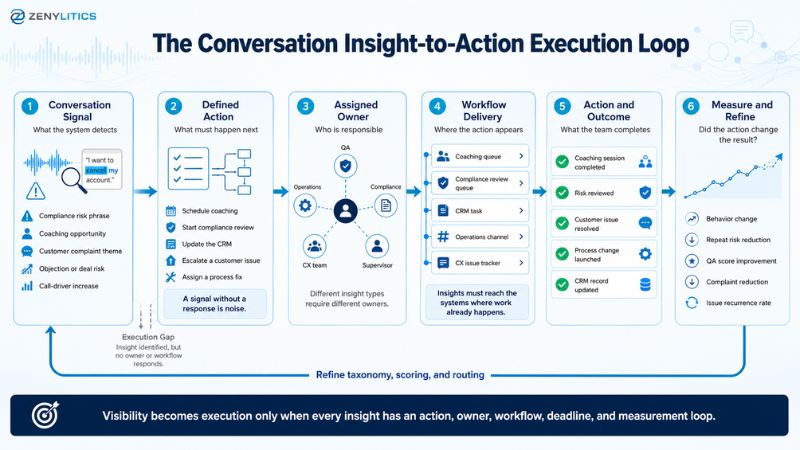
Insight does not equal action: A call summary is documentation. A sentiment score is a signal. A flagged phrase is a data point. None of these create a task, assign a reviewer, trigger a workflow, or change agent behavior unless a person or system converts them into an explicit next step. The gap between knowing something happened and doing something about it is where most programs stall.
Dashboards outside the real workflow: Conversation intelligence outputs typically live in a separate tool from where work actually happens. A QA director reviewing a dashboard has to manually translate what they see into a coaching action, a compliance review queue, or a CRM update. That manual step is where most insights die. When the conversation intelligence tool is a separate tab and the workflow lives in another platform, every insight has to travel manually before it can reach the system where someone will act on it, and by the time it arrives, the situation has often already moved.
No assigned owner: Most conversation intelligence programs do not answer the question of who is responsible for acting on a specific type of finding. A missed compliance phrase, a repeated complaint theme, a call driver spike, and an agent coaching signal all require different owners. When ownership is unclear, insights accumulate without follow-through.
Coaching does not reinforce: A flagged call reviewed once does not change behavior. Sustained improvement requires repeated, tracked coaching tied to specific conversation evidence. According to contact center coaching research from Invoca, most managers can only review a small sample of calls manually, which creates a bottleneck between insight discovery and behavior change at the team level.
No closed loop: Without measuring whether actions produced outcomes, a program cannot improve. Collecting more data without tracking whether coaching conversations changed behavior, whether compliance reviews reduced repeat violations, or whether CX fixes reduced contact volume is a signal that the program is measuring activity rather than results.
How the Execution Gap Shows Up in Contact Centers
In a contact center, the execution gap appears across every major function.
| Area | Execution Gap |
| QA | Calls are scored, but coaching does not happen consistently |
| Compliance | Risk phrases are flagged, but review queues are not owned |
| CX | Call drivers are identified, but process fixes are not assigned |
| Agent coaching | Managers receive insights, but behavior change is not tracked |
| Operations | Dashboards show trends, but workflow changes do not follow |
Each of these gaps reflects the same underlying problem: the analysis produced a signal that nobody with clear ownership converted into a defined action within a defined timeframe. Guided Insights as a Service is designed specifically for this layer, providing the program management, scoring calibration, and structured delivery that moves findings from a dashboard into the workflows responsible for QA, compliance, and CX improvement. A common example is spotting churn risk from customer conversations without anyone assigned to follow up on it.
How to Close the Insight-to-Action Gap
Closing the gap requires a structured approach rather than more tooling.
- Define the execution goal before analyzing calls: Establish what business problem the program is solving before configuring categories, topics, or dashboards. QA improvement, compliance risk reduction, CX issue resolution, and agent coaching each require a different action architecture.
- Map every insight type to an action: Every signal the system surfaces should have a corresponding action defined in advance, whether that is a coaching session, a compliance review, a CRM update, a process fix, or an escalation. A signal without a defined response is noise.
- Assign clear owners: QA owns agent scoring. Compliance owns risk phrase review. CX owns call driver analysis. Operations owns process escalations. Supervisors own coaching conversations. Publish the ownership map before the program goes live.
- Push insights into the systems where work happens: Insights that require a person to log into a separate tool before acting will not generate consistent execution. QA scoring should feed into coaching workflows. Compliance flags should route to review queues. Call driver data should reach the operations team through the channels they already monitor.
- Set a review cadence: High-risk signals may require daily review. Coaching and QA trends may be weekly. The cadence should match the operational cost of delayed action for each signal type.
- Measure action completion, not insight count: Track whether coaching sessions happened, whether compliance reviews were completed, whether call driver fixes were implemented, and whether outcomes changed. Programs that track only transcription volume or dashboard views are measuring technology adoption, not program performance.
- Refine the model based on outcomes: Update keyword lists, scorecard criteria, routing logic, and topic taxonomy as the program matures. A program that does not refine based on what worked and what did not will produce diminishing returns over time.
Assigning owners and workflows before launch is covered step by step in our implementation checklist.
Software Alone vs Managed Analytics Execution
A conversation intelligence platform generates the raw material. Turning that material into consistent operational action requires taxonomy design, QA criteria, compliance routing, analyst interpretation, coaching workflow design, and stakeholder adoption. These are process and capacity problems, not software problems.
Teams that have conversation data flowing in but lack the internal analyst capacity or QA design expertise to act on it consistently find that the platform becomes a reporting system rather than an operational driver. Managed speech analytics programs address this layer directly, combining AI-enabled analytics with people and process expertise to move findings into the workflows responsible for QA, compliance, CX improvement, and agent coaching.
What to Measure After Insights Become Actions
| Execution Area | Useful Metric |
| Agent coaching | Coaching sessions completed, behavior change over time |
| QA | Scorecard trend improvement, repeat issue reduction |
| Compliance | Review queue completion rate, repeat risk phrase reduction |
| CX | Call driver reduction, complaint theme reduction |
| Operations | Process fixes launched, issue recurrence rate |
Measuring these outcomes closes the feedback loop. It also produces the data needed to refine the program because a team that knows which actions changed outcomes can prioritize similar actions in future cycles. Tracking completed actions and changed outcomes is also the foundation for reporting conversation intelligence ROI to leadership.
Common Mistakes to Avoid
Treating dashboards as execution is the most common error. A dashboard that a team reviews weekly is a reporting tool, and a reporting tool does not ensure that anyone acted on what it showed.
Other frequent mistakes include measuring transcript volume instead of action completion, sending alerts without assigning owners, relying on AI sentiment as a final decision rather than a review signal, creating insights without defined QA or compliance workflows, and purchasing more tooling when the actual constraint is process ownership and analyst capacity. Research on contact center QA programs consistently shows that the intervention gap between when a signal appears and when a manager responds is where most performance improvement opportunities are lost.
FAQs
Why does conversation intelligence miss execution?
Conversation intelligence misses execution when insights are not connected to owners, workflow triggers, coaching reinforcement, or measurement loops. The system identifies what happened, but a separate process and team structure are required to determine what happens next.
What is the insight-to-action gap?
The insight-to-action gap is the delay or breakdown between when a conversation intelligence system flags a meaningful signal and when a team member takes a defined action in response to it.
Why are dashboards not enough?
Dashboards provide visibility into insights, but visibility outside the workflow does not create execution. Acting on a dashboard signal requires a manual step that most teams do not take consistently enough to produce reliable outcomes.
How can contact centers turn conversation insights into action?
Contact centers close the gap by defining what action each insight type requires, assigning a specific owner for each action type, routing insights into the systems where those owners work, and tracking whether actions were completed and whether outcomes changed.
Do teams need software or managed analytics support?
Teams with dedicated QA and analyst resources can often run a conversation intelligence program independently. Teams without that capacity typically need managed speech analytics support to convert platform outputs into consistent operational decisions.
If your organization has conversation data that is not producing consistent operational direction, a conversation analytics assessment is a direct starting point. Request a Conversation Analytics Assessment