Sales managers use conversation intelligence for sales coaching by reviewing call recordings, call transcripts, call summaries, rep scorecards, and flagged buyer signals instead of listening to full recordings end to end. The system records and transcribes sales calls, analyzes them for objections, competitor mentions, pricing discussions, and next steps, then surfaces specific coaching moments a manager can act on in a 1:1 or a team review.
What Conversation Intelligence Means in Sales Coaching
Conversation intelligence is software that records, transcribes, analyzes, and scores sales calls to extract conversation insights a sales manager can use for coaching. Call recording captures the audio. Conversation intelligence goes further by detecting keywords, talk-to-listen ratio, sentiment, and coaching-relevant moments, then connecting those findings to a rep scorecard.
| Capability | Call recording | Conversation intelligence |
| Captures audio | Yes | Yes |
| Creates transcript | Sometimes | Usually |
| Detects keywords and topics | No | Yes |
| Finds coaching moments | No | Yes |
| Connects insights to CRM | No or limited | Often |
Microsoft’s Dynamics 365 documentation confirms this distinction directly, noting that conversation intelligence gathers data from sellers’ call recordings and analyzes it to surface KPIs and coaching insights by team, seller, and call, which is a different function than simply storing the recording itself.
Conversation insights come from several inputs: call transcripts, speaker labels, CRM data, deal-stage context, sentiment, and tracked competitor mentions. The outputs a sales manager actually works with are call summaries, action items, talk-to-listen ratio, objection patterns, and time-stamped coaching moments tied to a specific point in the call.
How Conversation Intelligence Helps Sales Managers Coach Reps
Sales managers cannot manually review every call a team generates in a week. Conversation intelligence gives visibility without that requirement, surfacing call summaries and flagged moments so a manager can decide which calls deserve a full transcript review and which do not.
FIELD NOTE: Start review priority with calls that show coaching value or deal risk first. That means lost deals, low-score calls, pricing-objection calls, calls with no recorded next step, and calls from new reps. A high-performing rep’s routine renewal call is a lower priority than a stalled deal with a flagged competitor mentioned.
This shift also changes the quality of feedback. Instead of coaching from memory or a general impression, a manager can point to an exact moment. Microsoft’s seller-detail tooling lets a manager comment directly on the transcript at the point where a behavior occurred, which is closer to coaching from evidence than coaching from recollection.
Coaching also becomes more consistent across a team once it runs on a shared rep scorecard rather than each manager’s individual judgment. A standardized scorecard applied to discovery quality, objection handling, and active listening produces comparable feedback regardless of which manager is reviewing the call.
What Sales-Call Metrics Managers Should Review for Coaching
| Signal | What it shows | Coaching use |
| Discovery quality | Whether the rep uncovered buyer pain and context | Coach better questioning |
| Talk-to-listen ratio | Whether the rep dominated or listened | Coach active listening |
| Objections | Where the buyer resisted | Coach objection handling |
| Pricing mentions | Where cost concerns appeared | Coach pricing control |
| Competitor mentions | Where competitive risk appeared | Coach differentiation |
| Sentiment | Possible buyer reaction | Review with full context |
| Next steps | Whether the call moved the deal forward | Coach deal control |
Talk-to-listen ratio and related conversational-style KPIs, including average pause length and longest customer monologue, are tracked directly inside Microsoft’s conversation intelligence seller detail page, confirming these are standard metrics across enterprise platforms rather than a Zenylitics-specific framework.
Sentiment deserves a caution here. Sentiment is a review signal, not a verdict. A transcript can register negative sentiment from a tense but ultimately productive exchange, so a manager needs to read the surrounding context before using a sentiment flag as the basis for coaching.
Can Conversation Intelligence Help Managers Find Rep Skill Gaps
The most useful diagnostic step is separating a skill problem from a lead-quality problem, since the coaching response is different for each.
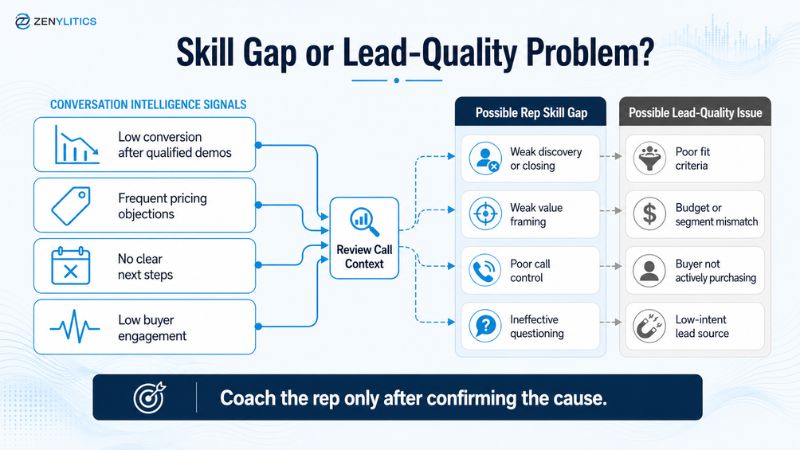
Conversation intelligence reveals whether poor results come from a coaching need or a lead-quality problem.
| Pattern | Possible skill issue | Possible lead-quality issue |
| Low conversion after qualified demos | Weak discovery or closing | Poor fit criteria |
| Many pricing objections | Weak value framing | Wrong segment or budget mismatch |
| No next steps recorded | Weak call control | Buyer not in active buying cycle |
| Low buyer engagement | Poor questioning | Low-intent lead source |
Once a manager confirms a genuine skill gap, top-performer comparison becomes the fastest way to build a coaching plan. Salesforce’s review of conversation intelligence software notes that platforms like Gong build coaching dashboards specifically to audit calls by topic and benchmark rep scorecards against winning patterns, which is the same underlying logic Zenylitics applies when building a coaching framework from call transcripts rather than generic training content.
A short library of strong call recordings, organized by scenarios such as a pricing objection or a competitor displacement, gives new reps a faster reference point than a written playbook alone. Avoid claiming a specific ramp-time reduction unless that number comes from a verified internal source.
Using Conversation Intelligence Without Creating a Surveillance Culture
Microsoft’s own documentation for this feature includes a direct usage warning, stating that the feature is intended to help managers improve team performance and is not intended for decisions affecting an employee’s compensation, rewards, or employment status. That distinction matters operationally as well as legally.
AI signals are not final judgment. Sentiment can misread context. Keyword mentions need the surrounding transcript to mean anything. Talk-to-listen ratio alone does not prove call quality. Manager review stays necessary at every step, and reps should know upfront why calls are reviewed and how the data is used.
If your team has call recordings but not enough time or analytics capacity to turn them into coaching action, Zenylitics can help convert that data into guided insights and measurable coaching priorities.
FAQs
Can AI replace human sales coaching?
No. Conversation intelligence can identify patterns, summarize calls, and surface coaching moments, but a sales manager still needs to interpret context, build trust with the rep, and coach behavior change directly.
How accurate is AI sentiment or tone analysis in sales calls?
Sentiment analysis should be treated as a review signal rather than final proof. Check the transcript, the surrounding call context, and the deal stage before using a sentiment flag to coach a rep.
Is conversation intelligence data secure and compliant with privacy rules?
It depends on the platform, jurisdiction, configured access controls, and your organization’s recording consent policy. Confirm compliance requirements with legal counsel before rollout rather than relying on platform defaults.