Contact centers generate more customer interaction data than most internal teams can realistically process. Conversation intelligence helps close that gap by capturing, transcribing, and analyzing customer interactions across channels, then surfacing patterns in QA performance, compliance language, customer sentiment, agent behavior, and call drivers that would otherwise stay buried inside unreviewed recordings.
The value of conversation intelligence does not come from the data itself. It comes from what a team does with the findings, which is why technology alone rarely solves the problem. This guide explains how conversation intelligence works inside a contact center, what it analyzes, and what it actually takes to turn analysis into operational improvement.
Key Takeaways
- Conversation intelligence analyzes call recordings, transcripts, sentiment, intent, and compliance language across full interaction volume
- Most contact centers currently review between 2 and 5 percent of calls manually, which means most patterns stay invisible
- Value depends on taxonomy design, QA criteria, workflow integration, and analyst review, not just platform access
- Real-time and post-call conversation intelligence serve different operational purposes and are not interchangeable
- Managed analytics support may be needed when internal teams lack the capacity to interpret and act on findings
What Is Conversation Intelligence for Contact Centers?
Conversation intelligence for contact centers is the application of AI-powered analysis to customer interactions, whether those interactions happen over the phone, through chat, or across other support channels. It captures interactions, transcribes them, and uses artificial intelligence technologies such as natural language processing and machine learning to identify key moments, customer sentiment, pain points, and other data.
In a contact center context, the focus is narrower than generic business conversation intelligence. The analysis centers on agent behavior during customer interactions, QA compliance against internal scorecards, compliance language across the full interaction volume, and the patterns that explain why customers are contacting the business repeatedly.
How Conversation Intelligence Works in a Contact Center
1. Capture Customer Interactions
Calls, chats, and other conversations are collected from contact center systems. Depending on the platform and configuration, this may include live calls, recorded calls, chat transcripts, or support tickets.
2. Transcribe and Structure the Data
Speech-to-text converts audio into searchable transcripts. Speaker labels, timestamps, topic tags, and metadata are applied so the content is usable for downstream analysis rather than sitting as raw audio files.
3. Analyze Conversations with AI
NLP and machine learning scan the structured data for keywords, sentiment, intent, compliance language, silence patterns, and topic trends. The AI layer identifies which moments in which conversations are worth surfacing to a human reviewer.
4. Surface Findings
Dashboards, alerts, QA scores, call summaries, and coaching signals give supervisors and QA teams a prioritized view of what is happening across interaction volume rather than requiring them to find it manually.
5. Turn Findings Into Action
QA teams review flagged conversations, adjust scorecards, and conduct coaching sessions. Compliance teams investigate flagged language and audit trails. CX leaders identify recurring friction patterns and make process changes. The analysis is only as useful as the action it informs.
What Data Does Contact Center Conversation Intelligence Analyze?
| Data Type | What It Helps Identify |
| Call transcripts | Customer issues, objections, agent responses |
| Chat conversations | Digital support patterns and unresolved issues |
| Keywords and phrases | Complaints, cancellations, competitor mentions, product issues |
| Sentiment | Frustration, satisfaction, escalation risk |
| Intent | Why the customer contacted support |
| Silence and hold patterns | Process friction or agent workflow issues |
| QA criteria | Script adherence, policy gaps, service quality |
| Compliance language | Required disclosures, risky phrasing, dispute signals |
| Call drivers | Repeated reasons customers contact the business |
Key Features of Contact Center Conversation Intelligence
A functional contact center conversation intelligence program typically includes transcription, sentiment analysis, topic detection, intent detection, keyword and phrase tracking, call summaries, real-time alerts, QA scoring, agent coaching signals, compliance monitoring, dashboards and trend reporting, and CRM or contact center system integrations.
The features that drive the most operational value in contact centers specifically are QA scoring at scale, compliance phrase monitoring, and the coaching workflow that connects flagged calls to a supervisor’s next action. These three are what separate conversation intelligence from a basic transcription or call recording system.
Field Note: The industry standard for manual QA review sits at 2 to 5 percent of total call volume. At that coverage rate, a compliance issue, a coaching pattern, or a call driver shift can accumulate for weeks before appearing in a review cycle. Conversation intelligence applied across full call volume changes the detection timeline substantially.
Benefits of Conversation Intelligence for Contact Centers
Better Customer Experience Visibility Recurring friction, complaint themes, sentiment trends, and service gaps surface from real conversation data rather than from post-call survey samples that typically represent a fraction of actual customer experiences.
Stronger QA Coverage Moving beyond a 2 to 5 percent manual sample allows QA teams to identify performance patterns that would otherwise go unseen. An agent whose compliance issue appears on call 47 out of 50 will not show up in a three-call manual sample.
More Focused Agent Coaching Coaching built on conversation data connects specific behavioral moments to specific calls, which gives supervisors evidence rather than impressions. When agents were asked what the fairest method of scoring phone calls was, the top response was “conversation intelligence with human review,” reflecting that agents themselves recognize the value of AI-scored evaluation over random manual sampling.
Compliance and Risk Visibility Automatic monitoring for required disclosures, risky phrasing, and complaint or dispute signals across full interaction volume reduces the risk of compliance gaps accumulating undetected between manual review cycles.
Faster Call Driver Discovery Identifying why customers are calling the business, and which reasons repeat most frequently, informs staffing decisions, IVR design, and self-service investment before the call volume data becomes a quarterly report.
Better Operational Decisions When operations leaders can see escalation causes, resolution rates, and sentiment patterns across the full interaction population rather than a sample, the decisions they make about staffing, training, and process changes are grounded in what is actually happening rather than what was observed in a small review batch.
Contact Center Use Cases by Team
| Team | Conversation Intelligence Use Case |
| QA teams | Scorecard review, quality trends, automated call scoring |
| Compliance teams | Disclosure checks, risky phrase detection, complaint monitoring |
| CX teams | Journey friction, sentiment trends, recurring customer pain points |
| Operations leaders | Call drivers, escalation causes, process bottlenecks |
| Supervisors | Agent coaching, performance patterns, training priorities |
| Collections teams | Objections, disputes, payment friction, recovery signals |
Conversation Intelligence vs. Conversational AI vs. Speech Analytics
| Term | Meaning | Contact Center Role |
| Conversation intelligence | Analyzes customer conversations for structured insights | Supports QA, CX, coaching, compliance, and operations |
| Conversational AI | Chatbots, virtual agents, or IVR systems customers interact with | Handles or automates conversations |
| Speech analytics | Analyzes voice and audio conversations specifically | Useful for call transcription, keyword tracking, sentiment, and compliance review |
Conversational AI refers to AI-powered systems including chatbots and virtual assistants that actively engage in real-time conversations with users, while conversation intelligence focuses on analyzing conversations to extract insights that inform business strategy rather than engaging users directly. The distinction matters for contact center technology decisions because buying a conversational AI platform and buying a conversation intelligence platform address different operational problems.
Real-Time vs. Post-Call Conversation Intelligence
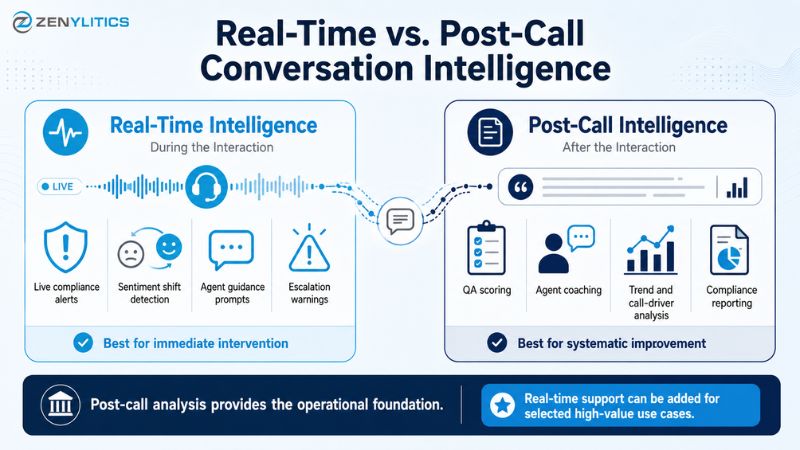
Real-time conversation intelligence supports immediate intervention during customer interactions, while post-call analysis provides the broader foundation for QA, coaching, compliance, and operational improvement.
Real-Time Conversation Intelligence
Applied during live interactions to surface alerts, compliance flags, sentiment shifts, and agent guidance prompts as the conversation unfolds. Useful for high-stakes compliance environments, complex sales conversations, and operations where an intervention during the call is more valuable than a review after it.
Post-Call Conversation Intelligence
Applied after conversations for QA review, trend analysis, coaching, compliance reporting, CX analysis, and operational planning. This covers the full interaction population rather than only the calls that are flagged for live monitoring, which makes it the primary layer for systematic QA and compliance programs.
Most contact center programs use post-call analysis as the operational foundation and layer in real-time capabilities selectively for specific use cases rather than applying them across all interactions.
What Contact Centers Need Before Implementing Conversation Intelligence
Running a successful program requires more preparation than platform access. Before going live, a team should confirm the following.
- A defined business goal tied to a specific operational outcome
- A chosen first use case rather than a simultaneous rollout across all departments
- Access to call and chat data in a usable format
- Recording consent and privacy review for the relevant jurisdictions
- A QA scorecard or compliance criteria to measure against
- A topic and keyword taxonomy calibrated to the business
- Dashboard and reporting requirements documented for the teams who will use them
- A named owner from QA, CX, operations, or compliance
- An agent and supervisor adoption plan
- A policy on human review for sensitive or high-stakes flagged conversations
Taxonomy calibration is the step most often skipped and the one most responsible for programs that produce data without producing useful findings. The AI processes whatever is in front of it. Whether the output answers a real business question depends entirely on how the categories and scoring criteria were designed.
Software Alone vs. Managed Analytics Execution
A conversation intelligence platform can capture interactions, generate transcripts, apply sentiment scores, and populate dashboards. What the platform does not do on its own is design the scorecard, calibrate the keyword taxonomy, interpret ambiguous findings, build the coaching workflow, or determine which compliance signals reflect a genuine risk versus a false positive in your specific regulatory context.
Contact centers that have conversation data flowing in but lack the internal analyst capacity or QA design expertise to act on it consistently find that the platform becomes a source of reports rather than a driver of operational change. The gap is not in technology. It is in the layer between what the analysis surfaces and what the operations team actually does with it.
Managed speech analytics support addresses that layer directly, providing the program management, taxonomy design, analyst interpretation, and executive reporting that makes findings usable for the teams responsible for QA, compliance, and CX improvement.
How to Choose the Right Approach
| Business Need | What to Look For |
| Improve QA coverage | Scorecards, call review workflows, supervisor dashboards |
| Reduce compliance risk | Alerts, phrase monitoring, audit trails, privacy controls |
| Improve CX | Sentiment, call drivers, complaint themes, journey friction |
| Coach agents | Coaching triggers, performance trends, call examples |
| Analyze multiple channels | Voice, chat, email, and support interaction coverage |
| Act during live calls | Real-time alerts and agent assist functionality |
| Lack internal analytics team | Managed analytics support and process ownership |
Common Mistakes to Avoid
The most frequent errors in contact center conversation intelligence programs are misidentifying the technology category, treating transcripts as insights, and purchasing a platform without defining what business question it needs to answer.
Other common errors include ignoring recording consent and privacy requirements specific to the jurisdictions the contact center operates in, relying on AI sentiment scoring without human review for sensitive decisions, measuring dashboard activity rather than operational outcomes, and failing to connect findings to QA, coaching, compliance, or CX workflows in a way that actually changes how the team operates.
FAQs
What is conversation intelligence for contact centers?
Conversation intelligence for contact centers is AI-powered analysis of customer interactions across calls, chats, and other channels that surfaces patterns in agent performance, compliance language, customer sentiment, and call drivers to support QA, coaching, and operational decisions.
How does conversation intelligence work in a contact center?
It captures customer interactions, transcribes them into searchable text, applies AI analysis to identify sentiment, topics, intent, and compliance signals, and delivers findings through dashboards, alerts, and QA scoring workflows for supervisors and operations teams.
How is conversation intelligence different from conversational AI?
Conversational AI engages customers directly through chatbots or virtual agents. Conversation intelligence analyzes conversations after they happen to extract operational insights for QA, compliance, coaching, and customer experience teams.
How does conversation intelligence help QA teams?
It allows QA teams to evaluate interactions at a scale that manual review cannot support, applying consistent scorecard criteria across full call volume rather than relying on a small sampled fraction of conversations.
Do contact centers need software or managed analytics support?
It depends on internal capacity. A contact center with dedicated QA analysts and taxonomy expertise can often run a program independently. Teams without that capacity typically need managed analytics support to turn platform output into consistent operational decisions.
If your contact center is capturing interactions but not getting clear operational direction from them, a conversation analytics assessment is a straightforward starting point. Request a Conversation Analytics Assessment