Speech analytics is mainly focused on analyzing voice and call interactions. Conversation intelligence is broader and usually connects conversation data to context, intent, QA, coaching, and business decisions across more than one channel. The two overlap because both rely on transcription, AI, natural language processing, sentiment analysis, and dashboards to turn raw audio or text into something a team can act on.
The right choice between them depends on which channels your customers actually use, what your QA program currently looks like, what your compliance obligations require, and whether your team has the capacity to turn insights into action once they exist. This guide breaks down where each technology fits and where they genuinely overlap.
Quick Comparison
| Attribute | Speech Analytics | Conversation Intelligence |
| Primary focus | Voice and call analysis | Broader conversation analysis |
| Main channels | Phone calls, voice recordings | Voice, chat, email, video, messaging |
| Core function | Transcription, keyword spotting, acoustic analysis | Context, intent, sentiment, QA scoring, coaching |
| Common outputs | Reports, alerts, compliance flags | Scorecards, coaching triggers, workflow actions |
| Best fit | Voice-heavy call monitoring | Omnichannel QA, CX, and coaching |
What Is Speech Analytics?
Speech analytics analyzes spoken interactions, usually phone calls or voice recordings, by converting audio into transcripts and detecting patterns within them. It looks for keywords, phrases, sentiment shifts, and acoustic signals such as tone, pitch, volume, and silence.
A typical speech analytics system works with call recordings, speech-to-text transcripts, keyword and phrase matches, compliance language, call categories, periods of silence or dead air, and acoustic markers like stress or escalation in a speaker’s voice. The output is usually a report, an alert, or a flagged category tied to a specific call.
What Is Conversation Intelligence?
Conversation intelligence captures, transcribes, and analyzes business or customer conversations to extract insight about context, intent, sentiment, topic progression, and what should happen next. IBM describes conversation intelligence as AI-powered tools that analyze business conversations, transcribe them, and apply AI, NLP, and machine learning to identify key moments, customer sentiment, and pain points.
A conversation intelligence platform typically tracks customer intent, conversation context, how a topic developed over the course of a call or chat, sentiment changes throughout the interaction, agent performance against a scorecard, coaching opportunities, how the issue was ultimately resolved, and the broader business outcome tied to that conversation. The output connects to a workflow, whether that is a CRM update, a coaching trigger, or a dashboard a manager actually checks.
Where the Two Overlap
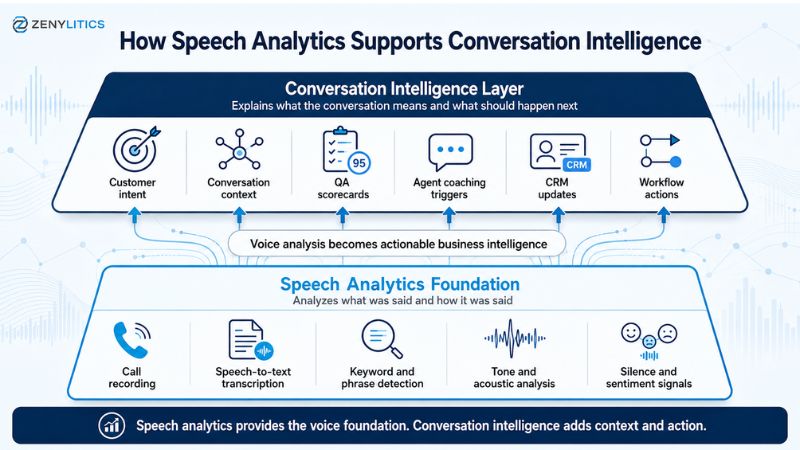
Speech analytics identifies what was said and how it was delivered, while conversation intelligence adds the context, scoring, coaching, and workflow actions needed to turn conversation data into business improvements.
The confusion between these terms exists because the underlying capabilities genuinely overlap. Both rely on conversation capture, transcription, keyword detection, sentiment analysis, topic detection, dashboards, and alerts.
Speech analytics is a foundational element of most conversation intelligence platforms rather than a separate competing category. The safest way to think about the relationship is that speech analytics is usually voice-focused, while conversation intelligence is usually broader and more action-oriented, often building directly on top of the speech analytics layer rather than replacing it.
Key Differences
Channel scope. Speech analytics is strongest for voice calls specifically. Conversation intelligence can include voice, chat, email, SMS, and video within a single analysis layer.
Analysis depth. Speech analytics often focuses on what was said and how it was said. Conversation intelligence focuses more on what the conversation actually means, why it matters to the business, and what action should follow from it.
Outputs. Speech analytics tends to produce transcripts, reports, alerts, and compliance flags. Conversation intelligence tends to produce scorecards, coaching triggers, CRM updates, and broader workflow actions.
Best-fit use cases. Speech analytics fits voice-heavy call monitoring, compliance phrase checks, and call-driver reporting well. Conversation intelligence fits omnichannel QA, coaching programs, and CX analysis that spans more than phone calls.
Technology layer. Speech analytics relies heavily on speech recognition, acoustic analysis, and keyword spotting. Conversation intelligence uses those same building blocks and adds context modeling, intent detection, and workflow integration on top.
When Speech Analytics Is the Better Fit
Speech analytics tends to be the right starting point when a business is mostly phone-based, when the priority is compliance phrase detection across recorded calls, when the team needs call-driver analysis without a full omnichannel rollout, or when the goal is a simpler voice-focused layer rather than a company-wide QA transformation. It also fits well for teams that are not yet ready to manage omnichannel workflows or full automated QA.
When Conversation Intelligence Is the Better Fit
Conversation intelligence becomes the better fit once customers are interacting across phone, chat, email, and messaging, and QA coverage needs to extend well beyond a small manual sample. It also fits teams that need scorecards, coaching triggers, or agent performance workflows connected directly to a supervisor’s day-to-day process, and teams whose goal has shifted from simply monitoring conversations to actively improving behavior and business outcomes from them.
Can You Use Both Together?
Most mature contact centers do not treat these as competing categories. Speech analytics can provide the voice-analysis foundation, while conversation intelligence adds context, scoring, coaching, and broader interaction analysis on top of that foundation. Many platforms today combine both approaches directly rather than forcing a choice between them.
The practical risk with running separate, disconnected tools is a workflow gap, where the speech analytics output sits in one system and the coaching or compliance workflow lives somewhere else entirely, with nobody responsible for connecting the two.
How This Applies to Contact Centers
QA coverage improves when speech analytics flags call patterns and keywords while conversation intelligence layers in scorecards and coaching workflows on top of those flags.
Compliance monitoring benefits from the same combination, since required disclosures and prohibited language can be flagged automatically while context-aware review catches the dispute or complaint signals that a simple keyword match would miss. Customer experience teams use both to identify friction points, repeated issues, and sentiment shifts across a much larger share of interactions than manual review alone would ever cover.
For collections-heavy operations, this combination also surfaces payment objections, dispute triggers, and missed recovery opportunities directly from call data rather than from a supervisor’s notes after the fact.
Software Alone vs Managed Analytics Execution
A platform can generate transcripts, reports, and dashboards on its own without much trouble. The harder part is everything that sits between that output and an actual business decision, including the taxonomy design, the QA criteria calibration, the compliance rules specific to your business, and the analyst review that determines whether a flagged call actually matters.
Teams without internal analysts or QA design capacity often find that the technology question was never really the hard part. The harder question is who takes ownership of turning the insight into an action, on an ongoing basis, once the initial setup is finished. [Internal link: Managed Speech Analytics Services]
How to Choose the Right Approach
| Situation | Better Starting Point |
| Mostly phone calls | Speech analytics |
| Voice plus chat, email, or SMS | Conversation intelligence |
| QA scorecards and coaching needed | Conversation intelligence |
| Have software but lack analytics capacity | Managed analytics execution |
Before committing to either path, it helps to ask which channels your customers actually use, whether the goal is monitoring calls or improving workflows, who on the team will interpret the resulting insights, and whether you have the internal capacity to maintain taxonomies and coaching workflows once the system is live.
Final Recommendation
Choose speech analytics if your main need is voice-call analysis, phrase detection, and call trend reporting. Choose conversation intelligence if you need broader context, omnichannel visibility, and coaching workflows tied to business action. Choose an integrated or managed approach if you need both the analytics layer and the operational process required to turn insights into measurable improvement.
Neither category is universally better. The right choice depends entirely on what your team is actually trying to solve.
FAQs
Is conversation intelligence the same as speech analytics?
No. Speech analytics typically focuses on voice and call data, while conversation intelligence is broader and usually spans multiple channels along with workflow integration.
Is speech analytics part of conversation intelligence?
Often, yes. Speech analytics frequently functions as the voice-analysis foundation that a broader conversation intelligence platform builds on top of.
Which is better for compliance monitoring?
Speech analytics handles phrase-level compliance flagging well on its own. Conversation intelligence adds the context needed to distinguish a real violation from a false match.
Which is better for QA and agent coaching?
Conversation intelligence tends to fit better here, since it connects flagged moments directly to scorecards and supervisor coaching workflows.
Do I need software or a managed analytics partner?
That depends on internal capacity. Teams with dedicated analysts can often run either technology independently, while teams without that capacity may need managed support to turn the output into action.