Conversation intelligence is the process of using AI to capture, transcribe, and analyze business conversations and then turn that raw material into structured insights that inform decisions across sales, service, quality assurance, and compliance. The technology relies on natural language processing and machine learning to identify key moments, customer sentiment, and pain points from calls, video meetings, and chat platforms.
This guide focuses on business conversation intelligence specifically rather than general human conversation skills. It applies to sales teams, customer service operations, contact centers, QA programs, compliance functions, and customer experience teams that need a clear picture of what is actually happening across their conversation volume.
What Is Conversation Intelligence?
Conversation intelligence software captures business conversations across channels, whether that is phone calls, video meetings, or chat interactions. The software transcribes these interactions and applies AI technologies such as natural language processing and machine learning to identify important moments, customer sentiment, and recurring pain points.
The result is structured rather than raw. A finished output usually includes a summary of the conversation, a sentiment score, a set of keyword and topic tags, and a list of flagged action items or objections that came up during the exchange. Forrester describes conversation intelligence for B2B revenue as tools that use natural language processing to capture unstructured data across conversation channels and convert it into searchable, structured insights.
The function at the core of all this is simple even when the technology underneath it is not. Raw conversation data goes in. Organized business intelligence comes out the other side.
How Conversation Intelligence Works
Conversation intelligence follows a consistent sequence regardless of which platform or vendor is involved.
| Step | What Happens |
| Data capture | Conversations are recorded or captured from calls, meetings, chats, or other channels |
| Transcription | Speech recognition converts audio into searchable text |
| Structuring | Speaker labels, timestamps, topics, and metadata get organized around the conversation |
| AI analysis | NLP and machine learning identify keywords, sentiment, intent, objections, and risk signals |
| Insight generation | The platform produces summaries, trend data, dashboards, and alerts |
| Workflow integration | Insights connect to CRM systems, QA tools, or contact center platforms |
| Business action | Teams use the output for coaching, compliance review, CX improvement, or sales follow-up |
Each stage depends heavily on the one before it. Weak transcription accuracy at the start of the process degrades every analysis step that follows. A platform that handles AI analysis well but has no workflow integration ends up producing insights that sit unused, since nobody downstream ever sees them in a format they can act on.
What Data Does Conversation Intelligence Analyze?
A conversation intelligence platform typically draws on several categories of information from every interaction.
- Speech-to-text transcripts
- Keyword and phrase mentions
- Sentiment across the full conversation
- Call duration and engagement patterns
- Flagged action items
- Customer intent signals
- Objections and pain points
- Pricing concerns
- Competitor mentions
- Complaint or dispute language
- Agent behavior patterns
- Compliance-relevant language
- Product feedback
Customer and sales conversations carry a substantial amount of information that goes unnoticed without structured analysis applied to them. The data already exists inside every call an organization records. What usually limits an organization is not the presence of the data but the capacity to extract it at any meaningful scale.
Key Features of Conversation Intelligence Software
| Feature | What It Does | Why It Matters |
| Call recording | Captures conversations for review | Creates the raw data source |
| Transcription | Converts speech into searchable text | Makes call content searchable and analyzable |
| Speaker identification | Distinguishes who said what | Improves the accuracy of every downstream analysis step |
| Sentiment analysis | Detects emotional tone | Reveals frustration, satisfaction, or risk in real conversations |
| Keyword detection | Tracks specific terms | Surfaces pricing mentions, objections, and complaints |
| Topic detection | Groups recurring themes | Reveals call drivers and customer issues |
| Summaries | Condenses long conversations | Reduces the time a human spends on manual review |
| Action items | Flags next steps | Supports follow-up and accountability |
| Dashboards | Shows trends over time | Helps managers identify patterns across a team or program |
| Alerts | Flags risks or opportunities | Speeds up response time when something needs attention |
| Integrations | Connects to CRM or contact center systems | Makes insights usable inside workflows people already follow |
Conversation Intelligence vs. Conversational AI, Speech Analytics, and Call Recording
These terms get used interchangeably in casual conversation, which creates real confusion once an organization starts evaluating platforms.
| Term | What It Means | How It Differs |
| Conversation intelligence | Analyzes conversations to extract business insights | Focused on understanding and acting on conversation data after the interaction happens |
| Conversational AI | Automates conversations through chatbots or virtual assistants | Engages directly with users rather than analyzing past conversations |
| Speech analytics | Analyzes spoken interactions, often inside contact centers | Usually voice-first and frequently sits as one component within a broader conversation intelligence approach |
| Call recording | Records audio for later review | Captures data without analyzing what it means |
| Call tracking | Tracks source, duration, and caller attribution | Measures call activity rather than conversation content |
| Revenue intelligence | Uses revenue data and buyer signals to inform sales strategy | A broader pipeline category that may incorporate conversation intelligence as one part of it |
Conversational AI refers to systems that engage directly with users in real time, like a chatbot answering a question on a website. Conversation intelligence works differently. It analyzes a conversation after it has already happened, pulling out patterns and signals that inform a decision someone makes later.
A chatbot responding to a pricing question is conversational AI doing its job. The later analysis of that recorded exchange, run across thousands of similar conversations to find a pattern in how people ask about pricing, is conversation intelligence.
Benefits of Conversation Intelligence
Organizations that put conversation intelligence to work tend to report a fairly consistent set of outcomes.
Customer sentiment and pain points become visible across the full conversation volume rather than through occasional manual sampling. Review time drops because AI handles the first pass of transcription and categorization automatically.
Coaching becomes specific instead of general, since a manager can point directly to a moment in a real call rather than offering vague feedback. When sentiment analysis reveals that customers frequently express frustration about wait times, a team has a concrete reason to prioritize faster response times rather than guessing at what to fix.
QA visibility extends well beyond the small sample sizes that manual review alone can support. Compliance and risk detection improve because every interaction gets evaluated against the same criteria instead of depending on whichever calls happened to get pulled for review. Revenue and sales insight sharpens because objection patterns and buying signals surface across the full call population, not just the handful of calls a manager happened to listen to that week.
None of this happens automatically just because a platform gets turned on. The results depend heavily on data quality, how well the taxonomy was designed, and whether the organization has the capacity to actually act on what the analysis surfaces.
Conversation Intelligence Use Cases by Team
| Team | Use Cases |
| Sales | Objection handling, pricing concerns, competitor mentions, coaching, pipeline risk |
| Customer service | Sentiment tracking, recurring complaints, escalation causes, service gaps |
| Contact centers | Agent performance, QA coverage, call driver analysis, workflow improvement |
| QA teams | Scorecard support, script adherence, automated call review, quality trend tracking |
| Compliance teams | Required language verification, risky phrasing detection, dispute signal monitoring |
| CX teams | Friction point identification, pain point tracking, voice-of-customer analysis |
| Product teams | Feature request patterns, defect reports, recurring feedback themes |
Conversation Intelligence for Contact Centers
Contact centers generate a volume of conversations that manual QA cannot realistically keep pace with. A team reviewing a small sample of calls each month is making decisions based on a thin slice of what actually happened across the operation that month.
Automated quality management systems are built to analyze up to 100 percent of interactions instead of relying on limited manual sampling, which gives leadership a complete view of performance, compliance, and customer experience rather than a partial one.
That move from sampled review to comprehensive coverage changes what a QA or compliance team can realistically catch. Call drivers, complaint themes, sentiment shifts, and agent performance patterns become visible across the entire operation instead of staying hidden inside whichever calls happened to get pulled that week.
Coverage on its own does not solve the underlying problem though. An organization can analyze every single call it records and still fail to turn that volume of output into a coaching program, a compliance fix, or a decision an executive actually acts on. Getting from comprehensive analysis to comprehensive understanding requires a defined business question driving the analysis, a calibrated scoring framework behind it, and a team responsible for interpreting what the numbers actually mean for that specific business.
Software Alone vs. Managed Conversation Analytics
A conversation intelligence platform captures and analyzes conversations well. Building the taxonomy that makes the analysis meaningful, calibrating the QA criteria to a specific business, interpreting ambiguous findings, and getting insights in front of the right decision-makers in a format they can use are all separate jobs the software does not do on its own.
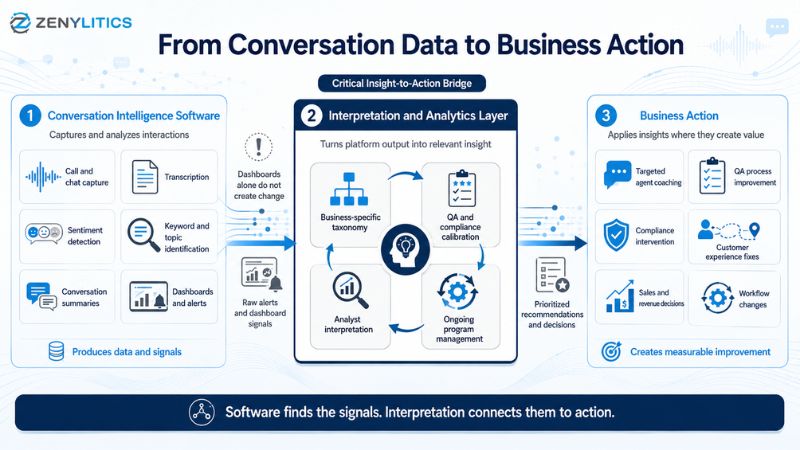
Conversation intelligence software identifies patterns and signals, while business-specific taxonomy, calibration, and expert interpretation convert those findings into coaching, compliance, quality, and operational improvements.
That gap is where a lot of organizations end up stalling after a strong start. The platform runs as expected. Dashboards populate with data. Reports go out on schedule. The piece that often stays underdeveloped is the connection between what the data shows and what the operation actually changes as a result, and that connection requires analyst time, domain expertise, and ongoing program management that most internal teams were never staffed to provide in the first place.
A managed analytics partner becomes useful at exactly this point, when a team has conversation data flowing in but lacks the time, the taxonomy expertise, or the analyst capacity to convert that data into action. This kind of support does not replace the underlying software. It fills the layer that sits between what the platform outputs and what the organization is able to do with it for QA improvement, compliance monitoring, coaching, or revenue decisions.
How to Implement Conversation Intelligence
Most implementations that hold up over time follow a fairly similar path. A team defines the business objective it actually wants to solve before touching any tooling. It picks one initial use case to start with rather than attempting a full rollout across every department at once. It identifies which data sources will feed the system and confirms recording and consent requirements for the relevant jurisdictions before anything goes live. From there it builds the keyword and topic taxonomy, sets the QA or compliance scoring criteria, and connects the resulting insights into workflows the team already uses, such as a CRM or a coaching tool. The team pilots the approach with one group, measures the outcome against the original objective, and expands based on what that pilot actually reveals.
Skipping the taxonomy and scoring calibration step is the most common reason an implementation underdelivers later on. The AI itself can process call volume from day one without any trouble. Whether that processing produces something useful depends almost entirely on whether the categories and scoring logic reflect the business questions that actually matter to that specific organization.
Risks, Limitations, and Privacy Considerations
Conversation intelligence comes with real limitations worth understanding before an organization commits to it. Speech recognition and sentiment analysis are not always fully accurate, and organizations need to account for privacy requirements, particularly in regions with strict data protection laws, along with the cost and complexity of integrating these tools into the rest of the business.
Sentiment analysis can misread context fairly easily, especially in conversations involving sarcasm, industry-specific terminology, or emotionally complicated situations. Poor data quality at the input stage, whether from background noise, strong accents, or general call quality issues, produces weak analysis no matter how advanced the underlying AI happens to be.
Teams working with regulated data, particularly in healthcare or financial services, need to confirm recording consent requirements ahead of time and apply the right access controls, retention policies, and audit trails around that data. AI output works best when it informs human judgment rather than replacing it outright, especially in compliance-sensitive interactions where missing a signal can carry a real cost.
How to Choose a Conversation Intelligence Approach
| Criterion | What to Ask |
| Use case fit | Are we solving for sales coaching, QA, compliance, CX, or operations? |
| Data sources | Which calls, meetings, or chats need to be analyzed? |
| Accuracy | How accurate is transcription, speaker labeling, and topic detection in our specific environment? |
| Integrations | Does it connect with our CRM, helpdesk, or contact center platform? |
| Privacy and security | Does it meet our data handling, consent, and audit requirements? |
| Reporting | Can leadership see trend-level data rather than only individual call summaries? |
| Workflow adoption | Where will the insights actually surface, and who is responsible for acting on them? |
| Internal capacity | Do we have the analyst and process resources to use this well, or do we need managed support? |
That last question gets skipped more often than any other on this list, and it tends to be the one that ends up determining whether the investment produces real results.
FAQs
What is conversation intelligence in simple terms?
Conversation intelligence is AI technology that analyzes business conversations, such as calls and meetings, to identify patterns, sentiment, and insights that inform decisions across sales, service, and operations.
How does conversation intelligence work?
It captures conversations, transcribes them into text, applies AI analysis to identify sentiment and topics, and generates structured insights that connect to existing business workflows.
What is the difference between conversation intelligence and conversational AI?
Conversational AI engages directly with users in real time, such as a chatbot. Conversation intelligence analyzes conversations after they happen to extract business insights.
Is conversation intelligence the same as speech analytics?
Speech analytics typically refers to voice-first analysis, often within contact centers, and frequently functions as one component inside a broader conversation intelligence approach.
What data does conversation intelligence analyze?
Transcripts, sentiment, keywords, topics, action items, customer intent, objections, and compliance-relevant language across recorded conversations.